
Choose a deck railing as a complete guard system, not an accessory that simply matches the boards. Slim aluminum balusters suit homeowners who want an open view without large glass panels to clean. Composite rails give a more substantial traditional outline. Cable can reduce visual obstruction but needs the specified posts, fittings, tensioning, and ongoing checks. Glass preserves a broad view but makes smudges, pollen, and access to both faces more important. Before choosing, confirm the required guard and stair details for the address, then compare the view from a seated position, safe cleaning access, post locations, and the full installed scope.
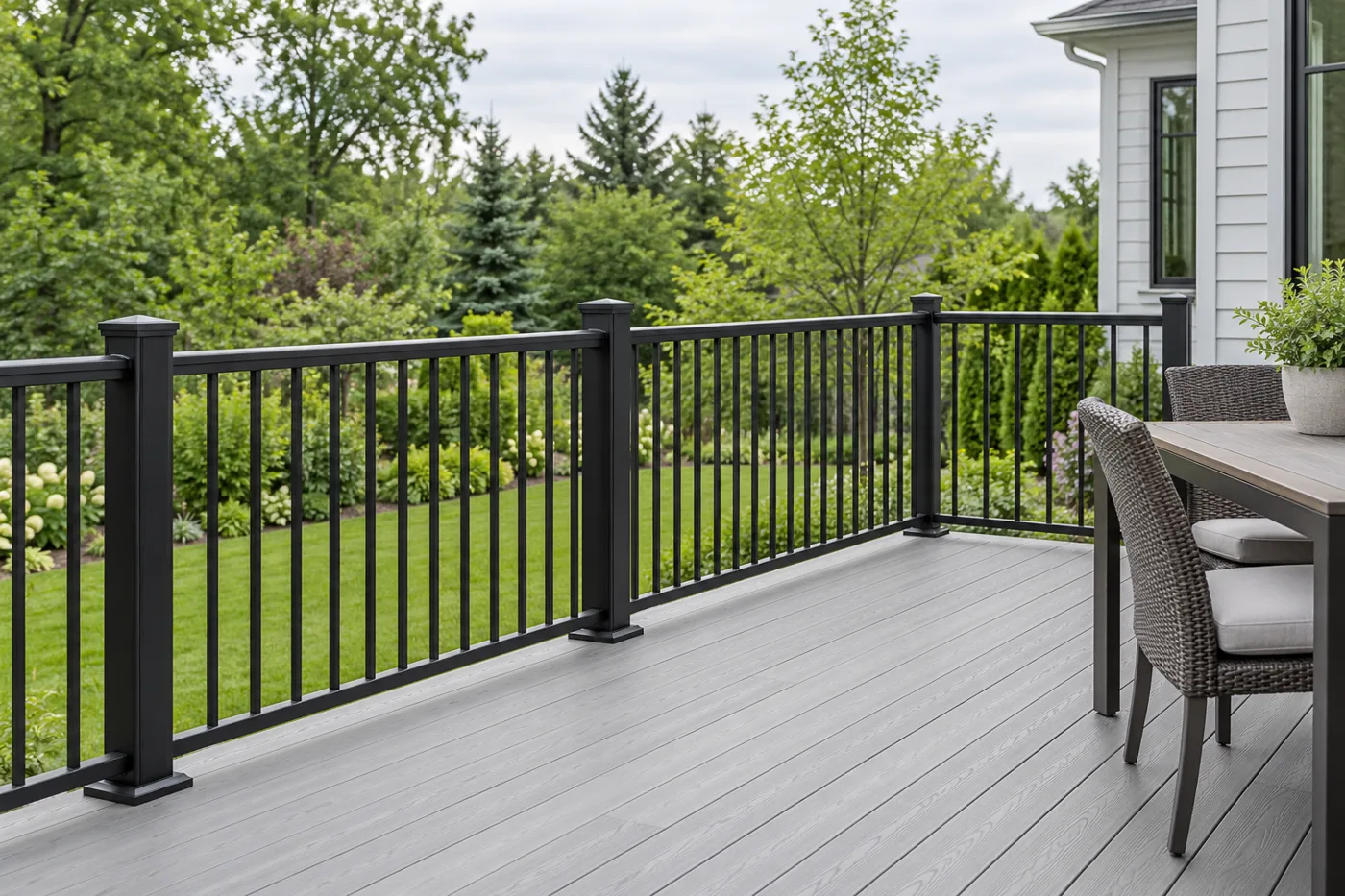
Start with the view you actually use
Stand at the back door, then sit where the dining chairs or lounge furniture will go. A top rail that looks unobtrusive from the lawn may cross the garden view at eye level from a chair. Broad posts can also interrupt a view even when the infill between them is visually light. Mark the proposed post positions on the deck plan before deciding from a small product sample.
For a Greater Charlotte backyard facing nearby homes, the most transparent option is not automatically the best. A guard is there to protect an edge; it does not necessarily provide privacy. Plan a separate, appropriate privacy treatment where needed rather than fastening panels or planters to a guard that was not designed for those loads. Keep the primary walking route and furniture away from arrangements that encourage climbing.
Aluminum balusters or composite rails?
A slim metal railing can keep the deck visually quiet. Dark vertical balusters often recede against trees and shaded planting, while a lighter railing may intentionally echo pale trim. Compare a full section outdoors: post size, top-rail profile, brackets, and bottom clearance affect the result as much as color.
Composite railing can create a more substantial porch-like outline. It may suit a home with broad columns or traditional trim, but the larger profiles can feel heavy around a compact deck. Composite decking and composite railing are separate product choices; using composite boards does not require matching composite rails.
Trex's current railing range illustrates the distinction between frame material and infill, offering several combinations rather than one universal railing. That is a useful way to compare proposals, not a promise that every brand, color, or combination is available for your project.
Cable and glass solve different view problems
Cable leaves an open view and does not create a continuous solid panel. Its performance depends on a coordinated assembly: end and intermediate posts, approved fittings, cable layout, tension, and connections to the deck. Ask how the chosen system is inspected and adjusted under its own instructions. Mixing attractive parts from unrelated systems can undermine the intended installation.
Glass provides a broad transparent surface, but it is not visually invisible. Reflections, water spots, fingerprints, and pollen can become noticeable against the view. Before choosing it, establish how both sides will be cleaned without leaning over a drop or improvising ladder access. An elevated deck can make exterior-face cleaning a significant ownership consideration.
Do not assume a glass guard is a suitable wind screen just because it is solid. Wind exposure, glass specification, posts, anchorage, and the overall assembly need project-specific review. Likewise, cable's open appearance is not evidence that any spacing or configuration is acceptable.
Resolve posts and stairs before ordering
The guard has to connect to adequate supporting structure. A decorative post sleeve, deck board, or fascia is not a substitute for the designed attachment below. On an existing deck, review the condition and connection details before treating railing replacement as a cosmetic swap. The approved system instructions and applicable requirements should govern post spacing, fastening, and infill.
Stairs deserve their own line in the proposal. A broad top rail that works well as a border or drink ledge may not serve as the required graspable handrail. Discuss stair transitions, returns, landings, and any separate handrail before comparing prices. Where a gate is wanted, its hardware, swing, and intended use also need to be specified; a deck gate is not automatically a compliant pool barrier.
Local requirements and HOA review depend on the property and scope. Ask the project team to confirm them for the address rather than borrowing guard dimensions or pool rules from an unrelated online photograph.
Compare care and the complete installed scope
All railing materials need appropriate care. Trex's care guidance distinguishes composite, metal, and glass cleaning rather than treating them as interchangeable. Use the current instructions for the exact installed product; do not assume a pressure-washing method approved for deck boards is suitable for the railing finish, fittings, or glazing.
Compare estimates using the same perimeter, post layout, stair runs, gates, and accessories. Include structural work needed at post connections, removal of existing rails, finishing around posts, lighting where selected, and any separate stair handrail. A low per-foot figure is not directly comparable with a complete installed system.
Ask for a drawing or marked photograph showing the selected profiles and post positions. Review that beside actual decking and siding samples. Unique Patio Concepts can discuss a deck layout that coordinates the guard, stairs, furniture, and future outdoor-living plans instead of leaving railing as the final unresolved choice.
- Which exact system, infill, finish, and post profile are included?
- How are the posts attached to the underlying structure?
- Are stair handrails, gates, and transitions included?
- Can both sides be cleaned safely from accessible locations?
- What product-specific care and adjustment instructions will be supplied?
Plan the deck and railing together
Request a Greater Charlotte deck consultation with Unique Patio Concepts to compare railing styles, sightlines, stairs, and the complete installation scope.
Request a free estimateFrequently asked questions
Does composite decking need composite railing?
No. Compatible, properly designed aluminum, composite, cable, or glass guard systems may be considered. Choose the structure and connections for the project rather than assuming the decking material dictates the railing.
Is cable railing maintenance-free?
No. Follow the selected system's cleaning, inspection, and tension or adjustment instructions. An open appearance does not eliminate care or structural requirements.
Is glass railing the best choice for a garden view?
It can provide a broad view, but reflections, cleaning, safe access to both faces, and the specific guard design matter. Compare it from the actual seated viewing position.
Can the deck's top rail also be the stair handrail?
Not necessarily. The stair may require a separate graspable handrail and appropriate transitions. Have the project team confirm the exact assembly and applicable requirements.