
Choose K-BANA when you want a compact, freestanding outdoor retreat with manually adjustable louvers, standard module sizes, privacy-wall options, and no electricity required to operate the roof. Choose R-BLADE when the patio calls for a custom-sized motorized roof, wall-mounted or multizone possibilities, remote or automated controls, and a larger integrated accessory plan. Both use adjustable aluminum louvers and built-in drainage, but they solve different design problems. K-BANA is a modular cabana-style destination; R-BLADE is a custom architectural roof system. The better fit depends on the site, desired footprint, connection to the house, frequency of roof adjustment, electrical plan, accessories, and address-specific approvals—not simply whether manual or motorized sounds better.
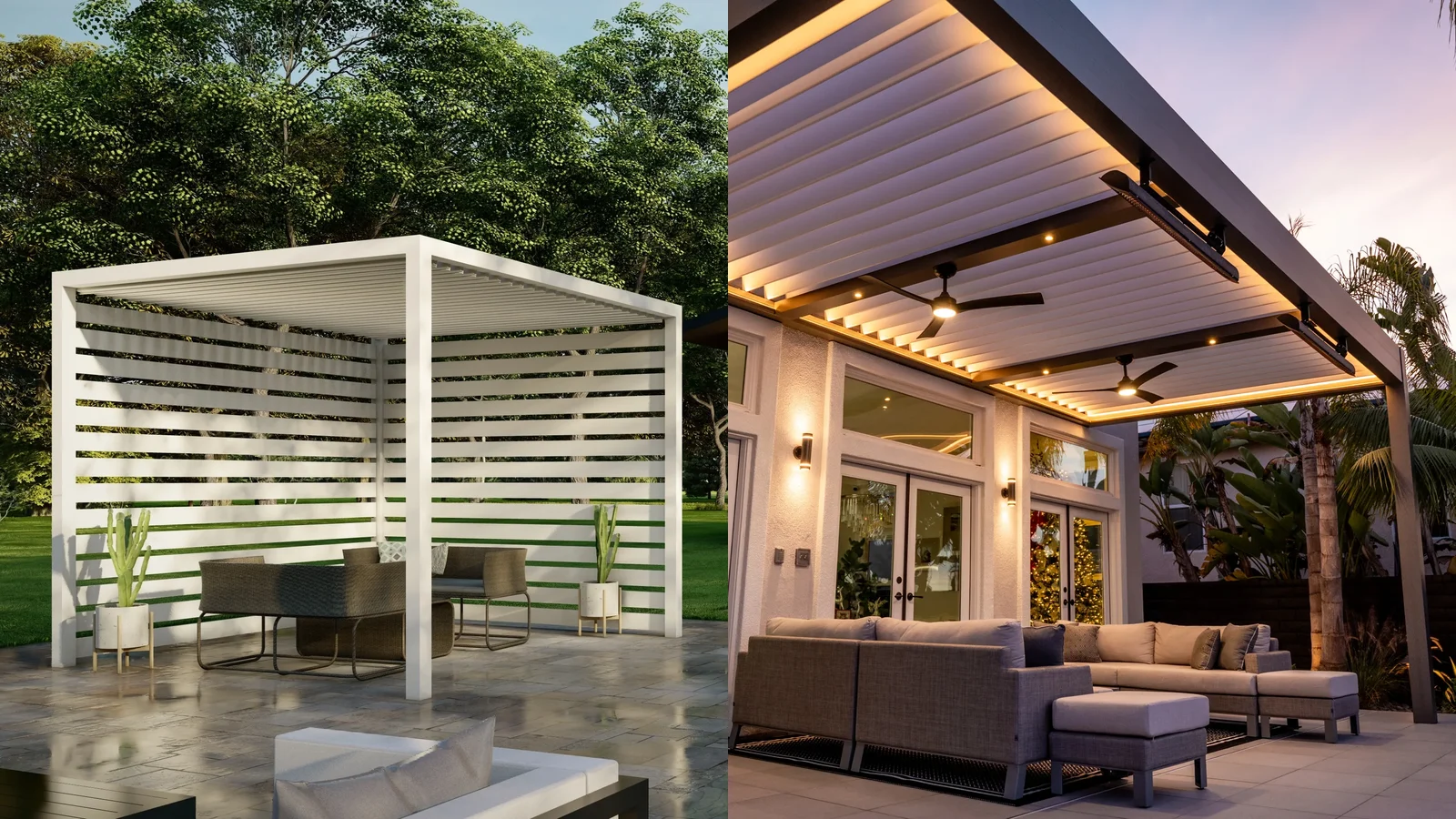
What Is the Main Difference Between K-BANA and R-BLADE?
K-BANA is a freestanding modular cabana with a manually adjustable louvered roof. Azenco currently offers anchored and platform editions, standard 10-by-10-foot and 12-by-12-foot modules, and configurations that can combine modules. The louvers rotate by hand, so the roof itself does not need a motor, remote, app, sensor, or electrical supply. That makes K-BANA especially useful as a defined lounge, poolside retreat, dining nook, or private destination set apart from the house.
R-BLADE is a custom motorized louvered pergola. Azenco presents it in wall-mounted, freestanding, multizone, and special-cut configurations, with controls and compatible options that can be coordinated into a larger outdoor-living plan. Its roof is intended for homeowners who want to adjust sun, shade, and airflow without walking to each louver zone and who may value automation, lighting, screens, fans, heaters, speakers, or other integrated features.
Both products can open or close overhead louvers and route roof water through an integrated drainage system. They are not small and large versions of the same kit. Their structure, available dimensions, attachment choices, controls, accessory paths, weather instructions, and engineered limits differ. Compare the exact current configuration rather than transferring a specification from one product family to the other.
Which Pergola Fits the Size and Location of Your Patio?
Start with the outdoor room, not the product name. Draw the back door, windows, eaves, gutters, pool edge, deck or patio, steps, utilities, drainage, furniture, grill, and primary walking routes. Then mark the roof area that truly needs shade. A standard module can feel generous around four lounge chairs but cramped around a dining table, outdoor kitchen, and circulation path. A custom roof can cover more space, but extra square footage is not useful if posts, downspouts, or accessories land in the wrong places.
K-BANA is strongest when one or more standard freestanding modules fit the yard naturally. Its cabana proportions can define a separate destination without requiring a wall connection to the house. The platform edition can create an integrated floor system, while the anchored edition relates to an existing suitable surface. The exact foundation or anchoring still has to match the approved design and site; a product being freestanding does not mean it can simply rest on lawn, loose pavers, or an unverified slab.
R-BLADE is the more flexible starting point when the pergola needs to meet the house, span a larger patio, follow an unusual footprint, create multiple roof zones, or coordinate closely with doors and indoor views. That flexibility adds design decisions. Wall-mounted layouts need a verified structural connection and flashing strategy. Freestanding and multizone layouts need clear load paths, post locations, foundations, and drainage that work with the patio, deck, pool, grade, and landscaping.
- Use K-BANA when a standard freestanding module creates the complete room you want.
- Use R-BLADE when dimensions, attachment, angles, or multiple activity zones require custom design.
- Measure furniture and walking clearances before comparing roof dimensions.
- Keep posts and drainage outlets clear of doors, stairs, pool paths, utilities, and low areas.
- Verify the supporting slab, deck, footings, or platform for the exact selected configuration.
Is Manual or Motorized Roof Control Better for Daily Use?
Manual control is not automatically inconvenient. On a compact K-BANA beside a pool or garden, the adjustment point is close and the roof may stay in one preferred position for long periods. No roof motor means no operating circuit, remote, app, sensor setup, or motor-service access. That simplicity can be valuable where the cabana sits away from the house or where the homeowner wants shade control without another connected system.
Motorization earns its place when the roof is larger, adjusted often, divided into zones, or integrated with other powered features. R-BLADE can change louver position from a control rather than requiring a person to operate the roof by hand. Azenco also describes remote, wall, app, smart-home, and sensor options for current R-BLADE configurations. Confirm exactly which controls and sensors are included in the proposed system and what each one does; do not assume every installation receives every automation feature.
Think about normal behavior during a changing day. If a homeowner wants to open the roof at breakfast, reduce glare at lunch, and close it when rain arrives, motorized control may be used regularly. If the roof mainly shades an occasional reading or lounge area, manual operation may be sufficient. The decision should reflect the number of users, accessibility, roof zones, distance from the house, power availability, and willingness to maintain controls—not technology for its own sake.
- K-BANA roof operation does not require electricity.
- R-BLADE needs a coordinated electrical and control plan for its motorized roof.
- Confirm control locations, sensor behavior, power-loss procedures, and manual instructions before installation.
- Keep operating hardware and serviceable components accessible after furniture and landscaping are added.
- Follow the installed manual and dealer instructions for rain, wind, freezing conditions, obstructions, and unusual movement.
How Do Weather, Drainage, and Accessories Change the Choice?
Azenco describes both roofs with adjustable louvers and integrated drainage, but their tested loads and operating guidance are product- and configuration-specific. A closed roof directs water toward gutters and discharge paths; it does not eliminate the need to manage water at the site. Show where each post or outlet releases runoff and keep that water away from the house foundation, doors, stairs, pool equipment, neighboring property, and any low area that already holds water.
The surrounding room matters during wind-driven rain. Water can still enter through open sides, beneath privacy walls, or at an exposed edge. Furniture and finishes should remain appropriate for outdoor use. Keep leaves, pollen, and debris from blocking visible drainage paths, and use ground-level observation and manufacturer-approved cleaning instead of climbing on louvers or forcing a roof that is obstructed or moving abnormally.
Accessory plans often favor R-BLADE because Azenco offers a broader custom integration path for lighting, motorized screens, fans, heaters, speakers, and other options. Compatibility is still not automatic. Fans need approved fixed structural mounting and safe blade clearance; heaters need their own clearances; screens need straight supported openings and operating space; cooking equipment needs an independent heat and ventilation plan. K-BANA can include privacy walls and may support selected accessories, but the exact current options should be confirmed instead of assuming every R-BLADE feature transfers to the cabana.
Which One Creates the Outdoor Experience You Want?
K-BANA reads as a destination. Its freestanding square module, optional privacy walls, and cabana proportions can frame a compact seating area in the lawn, beside a pool, or at the edge of a larger patio. It works well when the goal is to create separation from the house and a sense of enclosure without building a full room. Before choosing privacy walls, check seated views, breeze direction, late-day sun, furniture backs, and how people will enter and leave the space.
R-BLADE reads more like an architectural extension or complete outdoor roof. It can align with a broad patio, outdoor kitchen, dining zone, or multiple activity areas. A wall-mounted design can shorten the path from the house and preserve more open edges, while a freestanding design can still create a destination. Review the pergola from inside the house as well as from the yard so beams, louvers, and posts do not unnecessarily block important windows or views.
Both powder-coated aluminum structures need routine cleaning and inspection appropriate to the installed system. K-BANA adds manual roof hardware; R-BLADE adds motors, controls, sensors, and potentially more powered accessories. Neither should be described as maintenance-free. Keep the product manuals, approved drawings, finish information, control documentation, and service contacts with the home records.
A Greater Charlotte K-BANA vs. R-BLADE Checklist
For a Greater Charlotte property, document the site before requesting a proposal. Measure the usable patio or yard, doors, windows, eaves, deck framing, slab edges, pool clearances, grade, utilities, trees, easements, and drainage. Photograph sun and shade in the morning, midday, and late afternoon. List the furniture and accessories that must fit beneath the roof rather than choosing a pergola footprint from an empty plan.
Then compare two complete configurations. For K-BANA, identify module size, anchored or platform edition, manual operating access, privacy walls, foundation or surface requirements, drainage discharge, furniture, and circulation. For R-BLADE, identify exact dimensions and zones, wall-mounted or freestanding structure, roof controls, sensors, power, accessories, post locations, foundations, flashing, and drainage. Ask what is included, what is optional, and which current manufacturer documents govern the selected system.
Charlotte currently lists larger detached accessory structures among projects that can require concurrent Mecklenburg County and City review, while Mecklenburg County handles permitting and inspection for building and electrical work. The exact path depends on dimensions, attachment, foundations, electrical scope, address, zoning, setbacks, easements, HOA rules, and the jurisdiction outside Charlotte. Confirm current requirements for the complete project before ordering. Unique Patio Concepts can help compare both Azenco systems around the actual site and the way the backyard will be used.
- Choose the activity and furniture plan before choosing the roof system.
- Test whether a standard K-BANA module fits without compromising circulation.
- Use R-BLADE when the project needs custom size, attachment, zones, automation, or broader accessory integration.
- Map foundations, power, controls, gutters, and discharge points before fabrication.
- Compare current operating instructions and engineered limits for the exact proposed configuration.
- Confirm address-specific zoning, permits, setbacks, easements, utilities, HOA review, and inspections.
Compare manual and motorized pergolas for your backyard
Request a Greater Charlotte outdoor-living consultation from Unique Patio Concepts to compare K-BANA and R-BLADE around your site, layout, and priorities.
Request a free estimateFrequently asked questions
Does K-BANA need electricity?
Not to operate its manual louvered roof. Electricity may still be needed for separately approved lighting or other accessories. Plan those features and any required permits independently rather than assuming a powerless roof makes the entire project electrical-free.
Can R-BLADE attach to a house?
Yes, Azenco offers wall-mounted R-BLADE configurations as well as freestanding options. The house connection, structure, flashing, roof height, drainage, doors, windows, utilities, and permits must be designed for the specific home.
Can K-BANA modules be combined?
Azenco currently describes modular K-BANA configurations that can combine standard modules. Confirm the current supported arrangement, total footprint, foundations or platform, louver operation, drainage, privacy walls, and circulation for the proposed layout.
Do K-BANA and R-BLADE both keep rain out?
Both are designed to manage overhead rain when the louvers are in the prescribed closed position and the system is correctly installed, but open sides remain exposed to wind-driven rain. Site drainage, gutters, discharge, roof position, maintenance, and the exact product instructions still matter.
Which pergola is better for lights, fans, heaters, and screens?
R-BLADE generally offers the broader custom accessory and automation path. Every feature still needs manufacturer-approved structure, mounting, clearances, electrical design, drainage, and service access. Confirm K-BANA's current supported options rather than assuming the same accessory list applies.
Does a K-BANA or R-BLADE need a permit in Charlotte?
It may. Dimensions, attachment, foundations, electrical work, zoning, setbacks, easements, and the exact address affect review. Charlotte distinguishes permit paths by project type and size, and nearby jurisdictions can differ. Confirm the current requirements before ordering or construction.