
No. Azenco's K-BANA uses a manually operated louvered roof, so opening and closing the louvers does not require electrical service. That can simplify placement where running a new circuit would be inconvenient. Electricity becomes a separate choice if the outdoor room will include integrated or nearby lighting, receptacles, speakers, a television, heaters, fans, or other powered equipment. Keep those accessory loads separate from the basic roof decision: a power-free pergola can still need an electrical plan when the space around it includes powered features. K-BANA is a freestanding product offered in Anchored and Platform editions, so the site, support, drainage, access, and local approvals still need to be evaluated even when no motor wiring is required.
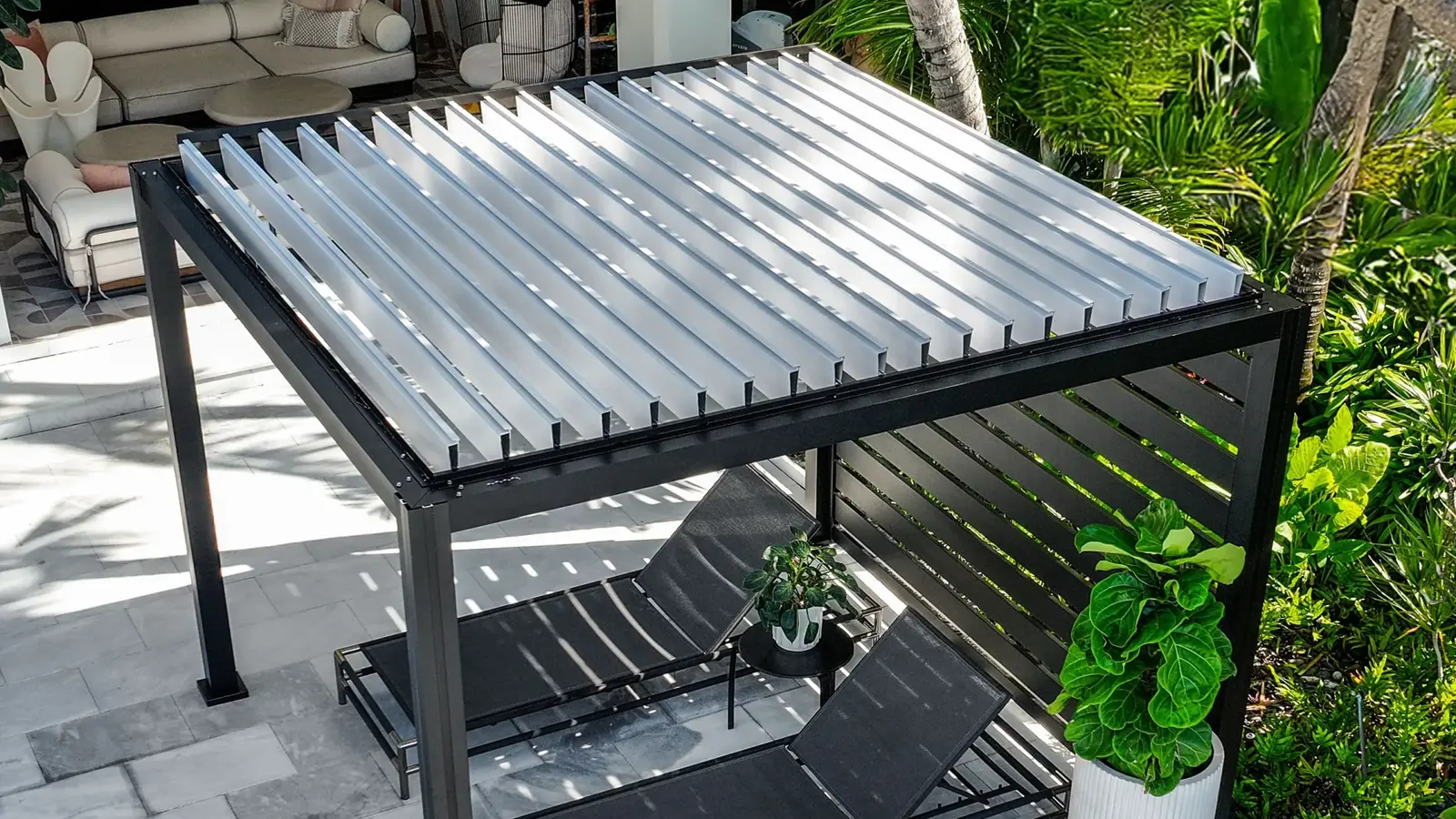
How Does K-BANA Work Without Electricity?
K-BANA controls light and shade with a manually adjustable louvered roof. Azenco states that the louvers can rotate through a 90-degree range and that the product does not need a power outlet to operate. The roof therefore has no motor that must be connected to a circuit before the louvers can move.
Manual does not mean fixed. You still choose a more open position for sunlight and airflow or rotate the louvers toward a closed position for shade and rain protection. The difference is how the movement happens: a person operates the manual mechanism at the pergola instead of pressing a remote or using an app.
This distinction is useful during early planning. A homeowner can evaluate the pergola footprint, sun angle, seating, privacy, surface, and drainage without first finding a practical route for motor power. It also avoids making roof operation dependent on a remote receiver, smart-home connection, or powered control.
Where Is a Power-Free Pergola Most Useful?
A manual roof can be a strong fit for a freestanding shade area that sits away from the house. Garden seating, a compact patio, or a poolside lounge may be easier to plan when the roof itself does not require a trench, conduit route, wall control, or outlet. This is especially relevant where an existing hardscape or finished landscape would make a new electrical path disruptive.
The benefit depends on how often you expect to adjust the roof. If you usually set the louvers for the afternoon and leave them there, walking to the pergola to make a change may feel simple. If you want frequent adjustments from inside the house, automatic rain response, or remote control across a large entertaining area, a motorized system may better match that routine.
No electricity also does not make every location suitable. The structure still needs a level, stable setting that matches the selected K-BANA edition. Keep doors, walkways, pool clearances, property constraints, trees, underground utilities, drainage, and maintenance access in the site plan. Convenience at the roof controls should not come at the expense of a cramped or poorly drained layout.
Which K-BANA Accessories or Patio Features May Still Need Power?
The roof and the outdoor room are two separate electrical questions. K-BANA can operate without power while the patio around it still uses electricity. Lighting, general-use receptacles, speakers, a television, powered shades, charging, landscape lighting, and some heating or cooling equipment can each create their own wiring and control requirements.
List accessories before installation even if you plan to add them later. A clean route for conduit or cable is easier to coordinate with the support, floor, pavers, landscaping, and furniture plan before the pergola is in place. Retrofitting after installation may expose raceways, disturb a finished patio, or put fixtures where roof movement, water, or seating creates a conflict.
Use equipment listed for the real outdoor exposure and follow its installation instructions. The louvered roof can admit sun and weather when open, and wind-driven moisture can reach areas that appear protected from directly overhead. Electrical design and installation should follow the requirements for the property and keep connections, controls, and service points accessible.
- Identify every desired light, receptacle, screen, speaker, television, heater, fan, and charger.
- Separate roof operation from accessory power so optional features do not get mistaken for basic product requirements.
- Coordinate wire and conduit routes with the selected edition, patio surface, drainage, furniture, and landscaping.
- Keep fixtures clear of moving louvers, manual controls, gutters, water discharge, and normal walking paths.
- Plan switches and controls where people enter and use the outdoor room rather than wherever wiring is easiest.
K-BANA or Motorized R-BLADE: Which Control Style Fits Better?
Start with behavior rather than assuming that more automation is always better. K-BANA suits homeowners who want adjustable louvers in a compact freestanding structure and are comfortable operating the roof at the pergola. Its manual roof eliminates the motor-power requirement and keeps the basic control direct.
R-BLADE uses a motorized louvered roof with powered controls. That is useful when push-button adjustment, remote operation, or automation is a priority. It also means the roof system needs an electrical and control plan, with equipment locations, wiring routes, weather protection, and service access coordinated before installation.
Size and configuration matter too. Azenco currently presents K-BANA in standard 10-by-10-foot and 12-by-12-foot sizes that can be combined into larger configurations. R-BLADE is a different product family intended for more customized motorized pergola projects. Compare the actual footprint, edition, roof controls, privacy needs, accessory package, and site conditions rather than treating the two systems as the same pergola with different switches.
- Choose K-BANA when manual control and power-independent roof operation suit the space.
- Compare R-BLADE when remote or automated roof movement is an important everyday feature.
- Show the actual seating and activity zones before choosing a standard module or larger combined configuration.
- Include future electrical accessories in either plan; a manual roof does not prevent a powered outdoor room.
- Review the complete site and product documents before treating control style as the only decision.
Does the Anchored or Platform Edition Change the Electrical Answer?
No. Azenco currently offers K-BANA in Anchored and Platform editions, and the manual roof itself does not require electricity in either version. The edition changes how the pergola meets the site, not how the louvers are powered.
The Anchored edition is intended to integrate with an existing surface. That surface and its connections still have to suit the selected structure, loads, site exposure, and approved installation. Pavers, thin patio slabs, and deck boards should not be assumed to provide adequate support merely because they look flat and finished.
The Platform edition includes a built-in floor and is presented as a more complete standalone structure. Azenco notes that it may not require anchoring or a permit in some locations, but that is not a universal Charlotte-area exemption. Site slope, soil, wind exposure, drainage, utilities, zoning, HOA rules, and the authority responsible for the address can still affect the installation.
Choose the edition early because it changes finished height, transitions, furniture placement, access, and how the pergola relates to grass, pavers, a pool deck, or another patio surface. If electrical accessories are planned, the edition also affects where wiring can enter and how it remains protected and serviceable.
What Should Greater Charlotte Homeowners Confirm Before Installation?
Prepare a measured plan that shows the K-BANA footprint, selected edition, louver orientation, manual control access, privacy walls, furniture, nearby doors, pool or spa, property boundaries, easements, trees, utilities, drainage, grade, and any powered accessories. Check the sun at the times you expect to use the space so the louver direction and privacy layout solve the right problem.
Mecklenburg County states that residential permits can apply to new construction and to electrical-system additions or changes, while some lower-cost work may qualify for an exemption only when listed structural, roofing, utility, or material conditions do not apply. Zoning and permit paths vary across Charlotte, nearby municipalities, Union County communities, and South Carolina service areas. Confirm the current requirements for the exact property and complete scope rather than assuming a manual roof makes the entire project permit-free.
Unique Patio Concepts can help compare K-BANA with motorized and fixed-roof alternatives, then coordinate the footprint, edition, shade pattern, privacy, drainage, furniture, and optional electrical features. The practical goal is not simply to avoid running power. It is to choose a pergola that is easy to operate and well matched to the way the outdoor space will actually be used.
- Confirm the exact K-BANA edition, size, finish, louver direction, and privacy-wall layout.
- Decide how often you want to adjust the roof and whether remote operation matters.
- List powered accessories separately and map their wiring, controls, and service access.
- Verify the surface, support, drainage, grade, and transitions for the selected edition.
- Check property-specific zoning, HOA, permit, structural, and electrical requirements before ordering.
Compare manual and motorized pergola controls
Request a Greater Charlotte outdoor-living consultation from Unique Patio Concepts to compare K-BANA placement, editions, shade, privacy, and optional power needs.
Request a free estimateFrequently asked questions
Does K-BANA need an electrical outlet?
No. Azenco states that K-BANA uses a manual louver system and does not need a power outlet for roof operation. An outlet or circuit may still be needed for optional lights, entertainment, heating, charging, or other patio equipment.
Can K-BANA louvers open and close without a motor?
Yes. The louvers are adjusted manually rather than by an electric motor. Azenco states that they can rotate through a 90-degree range to change sunlight, airflow, shade, and rain protection.
Can you add lights to a K-BANA pergola?
Lighting can be planned around the outdoor room, but it creates a separate electrical project. Confirm compatible fixture locations, outdoor ratings, wiring routes, controls, louver clearance, drainage, and service access before installation.
What is the difference between K-BANA and R-BLADE?
K-BANA is a freestanding modular pergola with manually adjustable louvers and no roof-motor power requirement. R-BLADE uses a motorized louvered roof with powered controls. Footprint, customization, operation, accessories, and site conditions should all be compared.
Does the K-BANA Platform edition need electricity?
No. The Platform edition includes a built-in floor, but its louvered roof remains manually operated. Electricity is optional for separate accessories, not required for basic roof movement.
Does a manual K-BANA pergola need a permit in Charlotte?
Do not assume it is exempt. The answer depends on the exact edition, location, support, size, site constraints, structural scope, optional electrical work, zoning, and the authority for the address. Confirm current requirements for the complete project before installation.