
Yes, a pergola can often be built near mature trees, but the right distance is not a single number you can copy from another yard. Tree species, health, trunk size, root spread, soil, grade, proposed footings, utilities, canopy condition, and construction access all affect the layout. Map the trees before fixing the pergola size. When excavation, grading, or equipment would enter an important root area—or branches may conflict with the roof—have a qualified arborist assess the trees and define protection measures before construction begins.
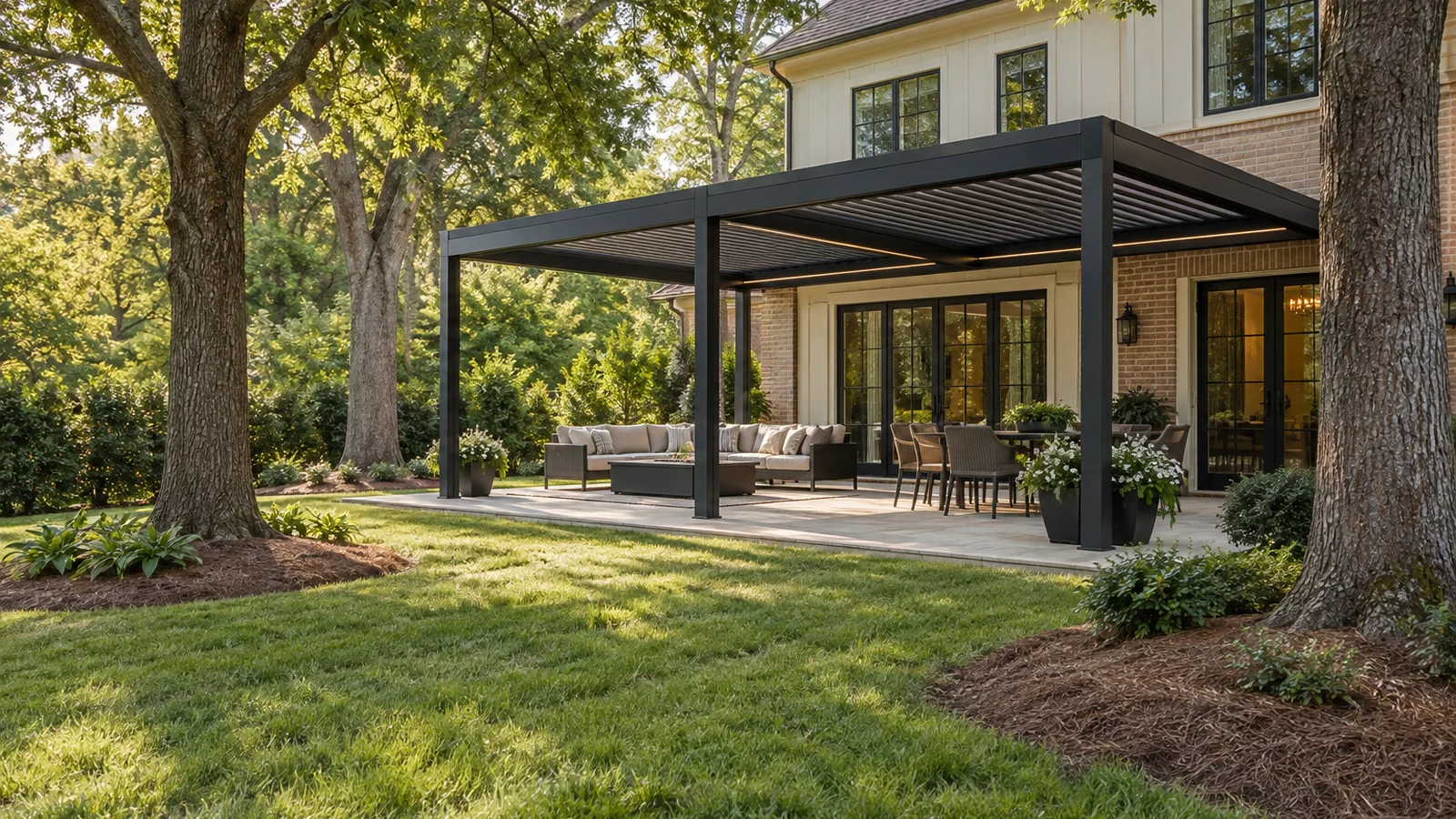
Map the Trees Before You Size the Pergola
Start with the entire backyard, not an isolated patio rectangle. Mark each trunk, the canopy edge, visible surface roots, existing patio or deck, doors, windows, utilities, slopes, downspouts, fences, and the route construction equipment would use. Then add the proposed pergola posts, beams, roof edge, drainage outlets, and any screens, lighting, or kitchen equipment.
This order matters because moving a post after the product is engineered is not the same as nudging a chair. Posts need foundations in specific locations, and a motorized or solid roof creates defined drainage and utility requirements. A layout that clears the trunk may still put a footing, electrical trench, or equipment route through sensitive soil around the tree.
NC State Extension recommends identifying priority trees and drawing tree-protection areas on the site plan before construction. That turns tree protection into a design input instead of a last-minute request to be careful. It also makes alternatives easier to compare: a smaller roof, a shifted post grid, an attached configuration, or a different patio edge may protect both the tree and the outdoor room.
How Close Can Pergola Footings Be to a Mature Tree?
There is no responsible universal setback for every tree. The canopy edge is useful to map, but it is not a wall around the root system. Research and arboriculture guidance describe tree roots as shallow and widely spread in many built landscapes, sometimes extending beyond the drip line. Species, age, trunk diameter, prior construction, soil depth, moisture, grade, and tree condition all change the risk.
A pergola footing can damage a tree in more than one way. Excavation may sever roots. Concrete placement and form work require additional space. Spoil piles and repeated foot traffic can compact surrounding soil. Moving the footing a small distance may miss one visible root while still affecting the broader root zone or tree stability.
For a mature tree worth keeping, ask an ISA Certified Arborist or another qualified arborist to evaluate the tree and proposed work before the footing plan is final. The arborist can help identify a practical protection area, flag trees that are poor candidates for retention, and coordinate with the designer when limited investigation or a different construction approach may be appropriate. This is a site decision, not a do-it-yourself root-cutting rule.
- Do not choose post locations from canopy clearance alone.
- Show the full footing excavation, not only the finished post width.
- Include electrical, drainage, gas, and low-voltage trenches in the root review.
- Treat large root conflicts as a reason to redesign, not permission to cut first and ask later.
- Recheck the plan if the pergola size, post grid, patio, or equipment route changes.
Protect the Soil, Not Just the Trunk
A tree can come through construction without a scrape on its bark and still be badly affected below ground. Heavy equipment, pallets, excavated soil, concrete washout, and repeated traffic compress pore space in the soil. Grade changes and added fill can alter oxygen and water movement around roots. Those effects may not become obvious until well after the patio furniture is in place.
Set the tree-protection area before demolition or excavation, then keep it clear. NC State Extension advises fencing protected root zones and excluding construction activity, equipment, and material storage. The access plan should be as deliberate as the footing plan: one defined route is easier to manage than letting every delivery choose the shortest path across the lawn.
If work must approach a protected area, stop and get project-specific direction. Do not expose roots with an ordinary trencher, drive over them because the ground looks firm, or bury them beneath extra soil to create a flatter patio. An arborist, designer, and contractor can decide whether the layout should move or whether a controlled method is appropriate for the actual tree and scope.
- Install and maintain visible tree-protection fencing before site work starts.
- Keep machines, stockpiles, mixing, washout, and parked vehicles outside the protected area.
- Avoid raising or lowering the grade around retained trees without qualified review.
- Give every trade the same tree-protection plan, including utility and landscape crews.
- Inspect the protection area during construction rather than assuming the first-day setup will hold.
Check the Canopy Above the Pergola
The roof needs room to operate and room to be maintained. Branches that barely clear an open pergola today may rub the beams as they grow or move in wind. Falling twigs, nuts, leaves, and storm debris can collect on louvers, roof panels, screens, and drainage channels. A branch directly over a motorized roof also complicates safe inspection and service.
Have the tree assessed for dead, broken, weak, or poorly attached limbs before the pergola is placed beneath it. Mature-tree pruning is not a matter of cutting back everything near the roof. The International Society of Arboriculture advises pruning for a reason and notes that improper work can create lasting damage. Work aloft or involving large branches belongs with qualified tree-care professionals.
Design for the tree that will continue growing, not just the photograph taken today. Preserve practical vertical and side clearance, keep service points reachable, and avoid a roof shape that traps branches between the tree and house. If enough clearance would require severe pruning or repeated canopy reduction, a shifted or smaller pergola may be the better long-term plan.
Coordinate Drainage, Debris, and Utilities
A roof changes where water reaches the soil. Closed louvers or a solid cover collect rain and direct it to specific outlets. Do not discharge that water against a tree trunk, into a footing excavation, across the patio, or into a low area where roots already sit in wet soil. Map existing downspouts and yard flow, then choose a lawful, stable destination for the pergola runoff.
Trees also change the maintenance load. Leaves, flowers, seeds, and small branches can settle in gutters and channels. Azenco's general care guidance includes cleaning roof surfaces and checking drainage; the installed product manual and dealer instructions remain the final authority for the selected system. Keep the roof safely serviceable from approved access points and do not climb or stand on louvers.
Utilities need their own route. Motorized roofs, lighting, screens, heaters, and outdoor kitchens may require electrical, gas, water, or drainage work. Contact NC811 before excavation and confirm all member-utility responses, then arrange separate locating for private lines that are not covered. Route new work around both identified utilities and the tree-protection plan instead of solving one conflict by creating another.
- Show pergola outlets, house downspouts, grade, and low spots on one drainage sketch.
- Keep channels and maintenance points reachable without leaning ladders into branches or standing on the roof.
- Plan seasonal leaf and seed cleanup based on the actual trees above the structure.
- Locate public and private utilities before footing or trench excavation.
- Follow the installed pergola manual for cleaning, operation, and weather procedures.
What Should Charlotte Homeowners Confirm Before Building?
Tree rules depend on the address and project. Within Charlotte, development review can include Urban Forestry, zoning, and stormwater. The City also protects public street trees and certain heritage trees; its current Tree Manual says removal of a qualifying heritage tree without a permit or City-approved land-development plan is prohibited, subject to the manual's stated process and exceptions. Do not assume a tree is unregulated because it stands on a residential lot or because the pergola footprint looks small.
Building, zoning, setbacks, easements, HOA review, utility requirements, engineering, and tree protections vary across Mecklenburg County, nearby North Carolina towns, and South Carolina communities. Confirm the path for the actual property and complete scope. A freestanding frame, an attached motorized roof, and a pergola combined with a new patio or retaining wall may trigger different reviews.
A reliable sequence is simple: survey the site, decide which trees are priorities, obtain an arborist assessment where needed, test pergola layouts around the protection areas, verify utilities and drainage, then complete product engineering and approvals. Unique Patio Concepts can help compare outdoor-living layouts after the tree and property constraints are understood. That is more productive than selecting the largest roof first and trying to preserve the trees around it.
- Identify whether trees are private, in the public right-of-way, protected by an approval, or potentially subject to heritage-tree rules.
- Document the tree assessment and protection limits on the same plan used by the pergola contractor.
- Confirm footing, attachment, electrical, drainage, zoning, and permit requirements for the exact design.
- Protect the approved construction route and root areas until every trade is finished.
- Plan post-construction monitoring when an arborist recommends it.
Plan the pergola around the trees worth keeping
Request a Greater Charlotte outdoor-living consultation to compare pergola layouts after the site's trees, roots, utilities, access, and drainage constraints are identified.
Request a free estimateFrequently asked questions
Can a pergola post be installed inside a tree's drip line?
Do not assume it can. The drip line does not define the full root system, and the risk depends on the tree, soil, footing excavation, construction access, and the amount and location of root disturbance. Have a qualified arborist and the project designer review the specific layout before excavation.
Will cutting one tree root kill the tree?
The outcome cannot be judged from root count alone. Root diameter, distance from the trunk, which side is affected, tree species, health, soil, and other disturbance all matter. Do not cut a significant root to make a footing fit without qualified, project-specific direction.
Can pergola footings be moved around tree roots?
Sometimes a different post grid or pergola size can avoid a conflict, but post locations are structural and product-specific. Any revision must still satisfy the pergola engineering, foundation design, drainage, utilities, and tree-protection plan.
Should branches be trimmed before a pergola is installed?
Dead, damaged, weak, or conflicting branches may need professional attention, but pruning should follow an arborist's assessment rather than an arbitrary clearance cut. Large-tree work and pruning above ground should be handled by qualified tree-care professionals.
Will a louvered pergola work under trees?
It can, provided the structure has safe canopy clearance and a practical plan for leaves, seeds, twigs, drainage cleaning, roof operation, and service access. Follow the installed product's care and weather instructions and keep people off the louvers.
Do Charlotte tree rules apply to a backyard pergola project?
They may. The answer depends on the address, tree location and status, project scope, and whether City Urban Forestry, zoning, stormwater, public-tree, heritage-tree, HOA, or prior approval requirements apply. Confirm the current process before tree work or construction begins.