
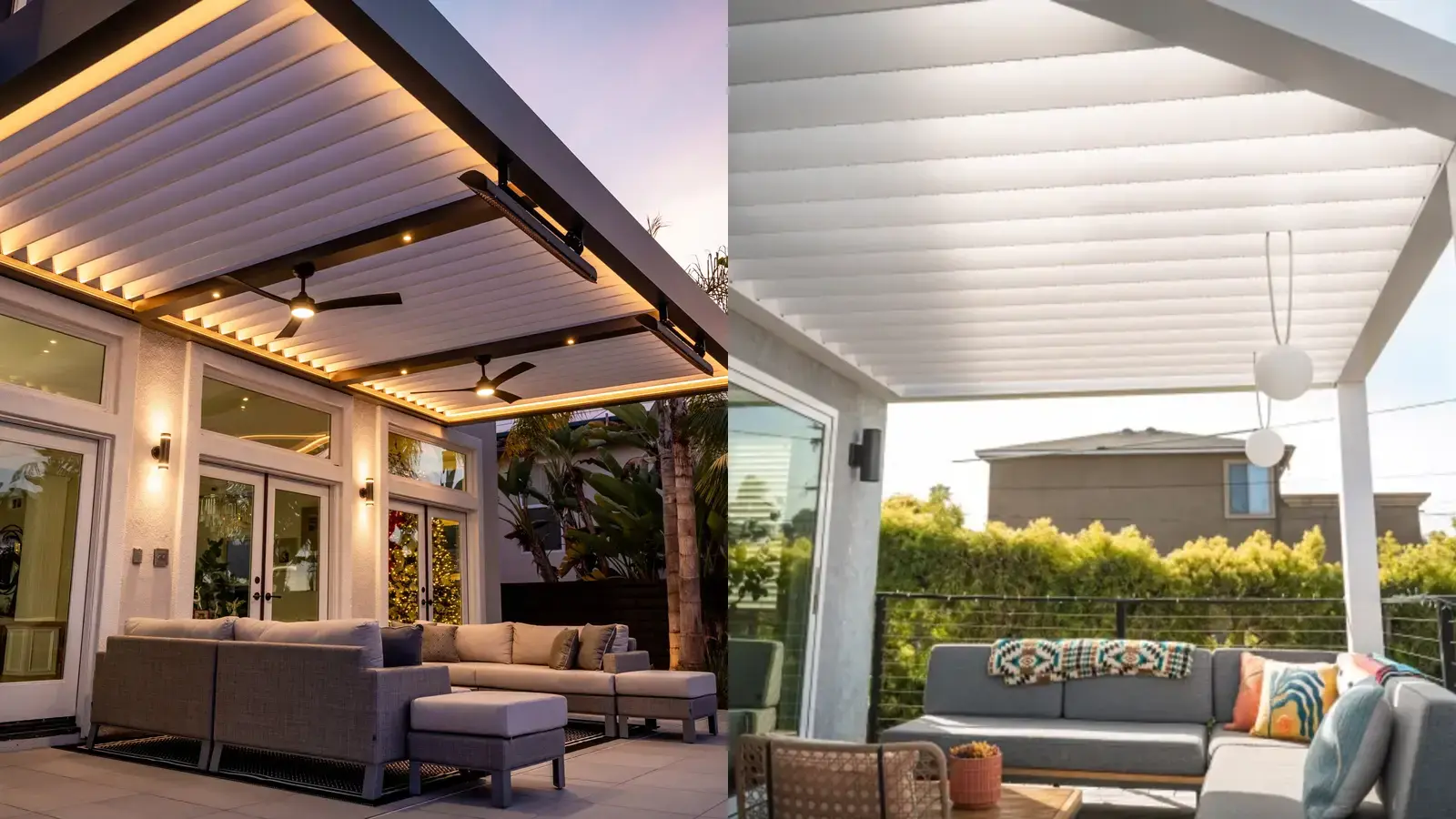
R-BLADE is usually the better fit when you want to open and close the roof, adjust overhead sunlight through the day, and use automatic weather controls. R-BREEZE makes more sense when you prefer a fixed architectural roof with dependable open-air shade, no roof motor, and a simpler day-to-day experience. Neither is automatically better for every Charlotte backyard. The right choice depends on whether rain protection or open-air shade matters more, how the patio faces the sun, which accessories you want, and what the house and site can support.
What Is the Main Difference Between R-BLADE and R-BREEZE?
The roof movement is the dividing line. Azenco's R-BLADE uses motorized aluminum louvers that rotate up to 90 degrees. You can open them for more sky and airflow, angle them for shade, or close the roof when you want overhead rain protection. Azenco also offers app, remote, wall-control, sensor, and smart-home options for the system.
R-BREEZE does not move. Its aluminum slats stay in a selected position: Azenco currently offers a 55-degree edition for angled shade and airflow, plus a 90-degree edition with vertical slats for stronger visual definition and privacy. The effect is more like a permanent architectural rhythm overhead than a roof you adjust throughout the day.
That one difference changes the whole decision. Do you want to manage changing weather and light at the touch of a button? Start with R-BLADE. Would you rather create a shaded, breezy outdoor room with no need to operate the roof? Put R-BREEZE at the top of the list.
Which Pergola Handles Charlotte Sun and Rain Better?
For flexibility, R-BLADE has the advantage. A Charlotte afternoon can move from bright sun to a fast shower, and adjustable louvers let the same patio respond. When closed, the roof directs collected water through its built-in drainage system. Open sides can still admit wind-driven rain, so think of it as overhead weather control rather than a sealed room.
R-BREEZE is built for open-air shade. The fixed slats filter direct sun while preserving openings for air and sky. They do not close into a rain roof. If keeping the dining table dry during a shower is a must-have, that distinction matters more than any finish or accessory.
Sun direction matters too. A roof that works beautifully at noon may not stop low western light at 6 p.m. Take patio photos in the morning, midday, and late afternoon. Note the season, the house shadow, and where people actually sit. Roof height, slat or louver direction, trees, and nearby walls all change the result.
How Do Controls, Power, and Maintenance Compare?
R-BLADE is the more capable system, and it also has more to coordinate. The motor, controls, sensors, lighting, and any screens need appropriate power, protected wiring, commissioning, and product-specific operating guidance. Homeowners should keep the roof and drainage channels clear, watch for unusual movement or sounds, and follow the installed manual rather than forcing an obstructed or frozen louver.
R-BREEZE removes the motorized-roof part of that equation. The fixed aluminum slats still need normal cleaning and ground-level checks for debris, finish condition, fasteners, drainage around the patio, and nearby branches. But there is no roof position to set and no louver motor to operate. Lighting, screens, fans, or other selected accessories may still require power and their own care.
Charlotte pollen deserves a practical mention. Either pergola can collect a yellow film in spring, especially near mature pines and hardwoods. Gentle cleaning with water and mild soap is a sensible starting point when it matches the manufacturer and installer guidance. Skip pressure-washing guesses, harsh chemicals, and climbing onto the roof.
Can Both Pergolas Use Screens, Lights, Fans, and Heaters?
Azenco presents both systems with options such as lighting, motorized screens, fans, heaters, cooling features, and speakers. That does not mean every accessory fits every span or layout. A fan needs an approved fixed mounting location and proper clearance; it should not hang through moving louvers. Screen cassettes and tracks need straight openings, power, and a clean landing surface.
Plan accessories before the posts, beams, patio edges, and electrical routes are final. Retrofitting a screen around a railing or squeezing a heater beside a door is where a polished outdoor room starts to feel improvised. The same goes for an outdoor kitchen: appliance clearances, ventilation, utilities, and roof compatibility come first.
Attached, freestanding, and multi-zone configurations are available, subject to the selected system and project engineering. The best layout is not necessarily the biggest one. It is the one that keeps doors, steps, furniture, grills, pool paths, views, and screen travel working together.
Which One Fits the Way You Use Your Backyard?
Pick the priority you will notice every week. If you want breakfast in morning sun, shade by midafternoon, and overhead cover during a passing shower, R-BLADE earns a closer look. If the patio is mainly a shaded lounge and you like the crisp look of fixed slats, R-BREEZE may give you exactly what you need without paying for roof movement you will rarely use.
Budget matters, but compare complete projects rather than roof names. Size, number of zones, attachment, foundations, drainage, finish, electrical work, screens, lighting, heaters, site access, engineering, and permits can all change an estimate. A simpler roof with several accessories may not be the simpler project.
Bring a short list to the site consultation: the hours you use the patio, how important rain protection is, where low sun enters, which furniture stays, and the accessories you truly want. Unique Patio Concepts can then compare both systems against the same measured Greater Charlotte site instead of asking you to choose from a brochure.
- Choose R-BLADE if changing sun, airflow, and overhead rain protection are top priorities.
- Choose R-BREEZE if fixed shade, open air, and architectural simplicity are the goal.
- Map low-angle sun separately from overhead sun; an open side may need a screen or another strategy.
- Confirm attachment, foundations, drainage, utilities, property constraints, and accessory locations before ordering.
- Check permit, zoning, HOA, and engineering requirements for the exact address and final scope.
Compare both pergolas on your actual patio
Request a Greater Charlotte site consultation and project-specific R-BLADE or R-BREEZE estimate from Unique Patio Concepts.
Request a free estimateFrequently asked questions
Does R-BREEZE protect a patio from rain?
R-BREEZE uses fixed slats with openings for light and airflow, so it should not be treated as a closed rain roof. If dependable overhead rain protection is a priority, compare it with R-BLADE in the closed position or a compatible solid patio-cover option.
Can R-BLADE louvers open all the way?
Azenco states that R-BLADE louvers rotate up to 90 degrees. The useful light and airflow at a specific patio will still depend on roof orientation, height, nearby structures, trees, and the sun angle.
Is R-BREEZE maintenance-free?
No outdoor structure should be ignored completely. R-BREEZE has no moving roof motor, but the aluminum, slats, accessories, nearby branches, and patio still benefit from routine visual checks and gentle cleaning that follows the manufacturer and installer guidance.
Can you add retractable screens to either pergola?
Azenco lists motorized screens among the available lifestyle features for both systems. The opening width, posts, tracks, cassette, floor edge, controls, power, wind guidance, and selected screen model must be coordinated for the actual project.
Which pergola is better for a west-facing Charlotte patio?
It depends on when and where the sun enters. R-BLADE adjusts overhead light, while a well-oriented R-BREEZE creates consistent fixed shade. Low western sun can pass below either roof edge, so document the late-day exposure and consider a compatible side-screen strategy when needed.
Do R-BLADE and R-BREEZE pergolas need permits in Charlotte?
Permanent structures commonly deserve building and zoning review, and electrical features may add trade-permit questions. Requirements vary by address, jurisdiction, attachment, foundations, size, and accessories. Confirm the current path for the final design before work begins.