
Yes, you can put a ceiling fan under many louvered pergolas in Greater Charlotte—but it needs to be part of the pergola design, not an improvised add-on. The fan should attach to a manufacturer-approved fixed beam or mounting location, never to or through moving louvers. Its blades need safe clearance from beams, lights, heaters, screens, doors, and the roof in every louver position. The fan, controls, wiring, and box must also suit the actual outdoor exposure and follow the approved electrical plan for the property.
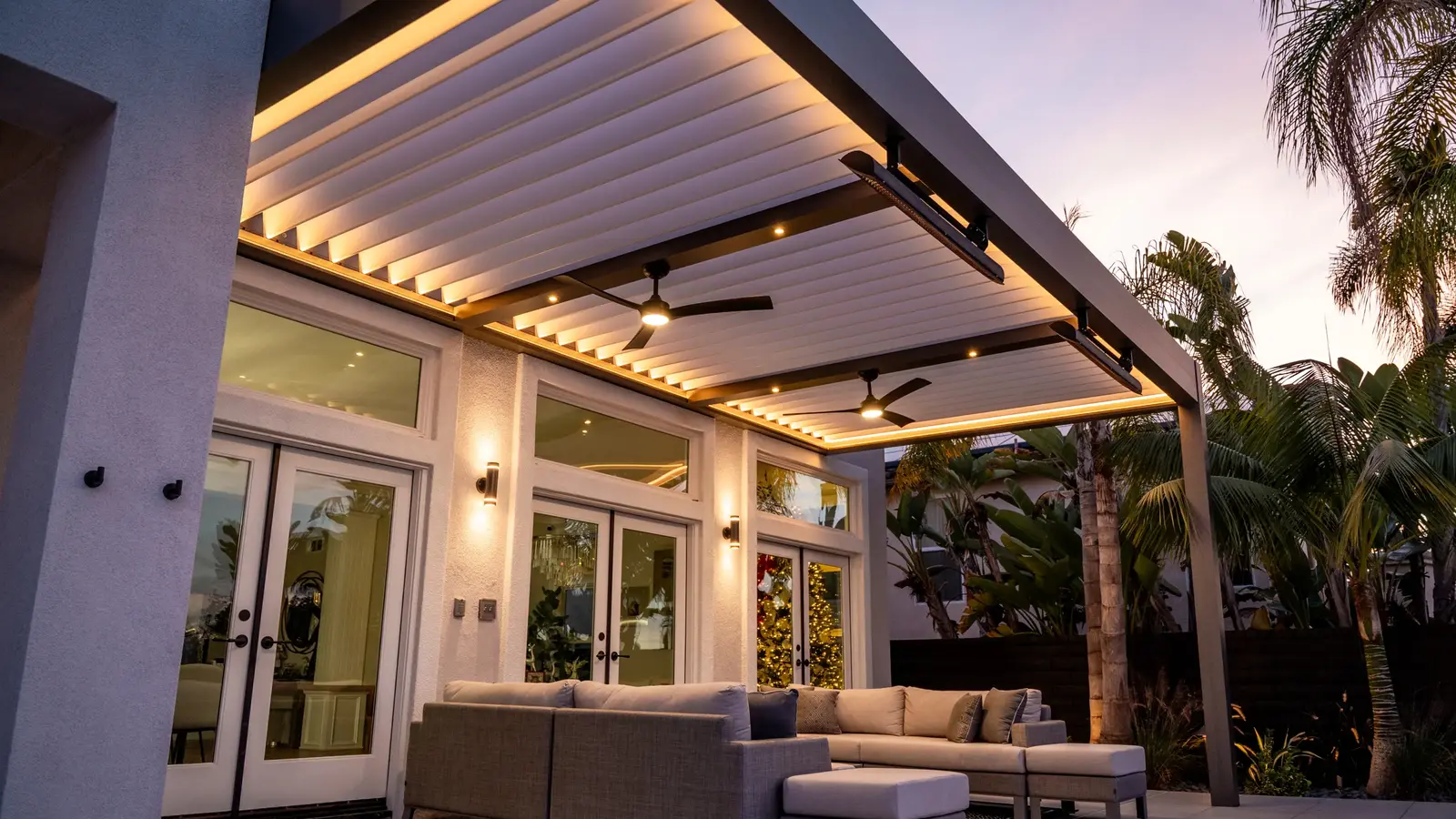
Why Add a Fan Under a Pergola?
Charlotte patios can feel still and humid even when the pergola is providing good shade. A ceiling fan adds air movement over the seating or dining area, which can make warm afternoons and evenings more comfortable. It does not air-condition an open patio or lower the outdoor temperature, but the breeze can make a noticeable difference where people actually sit.
Azenco presents fans as one of the comfort features available with its pergola systems, alongside options such as integrated lighting, heaters, and motorized screens. That does not mean every fan fits every roof. The pergola model, bay layout, attachment, height, accessory beams, electrical plan, and surrounding features still have to work as one design.
Planning early looks cleaner, too. Wiring can follow a deliberate concealed route, controls can land in a useful location, and the fan can align with the room instead of looking squeezed between louvers and lights.
Where Can the Fan Be Mounted?
The essential rule is simple: the fan needs a fixed, approved structural mounting point. Operable louvers rotate, so they are not a fan support and their movement cannot be blocked by a downrod, canopy, wire, or blade. A project may use a fixed accessory beam, a structural cross-member, or another manufacturer-approved detail, depending on the pergola configuration.
Do not assume an empty-looking spot in the roof is available. The frame may contain motors, drive components, drainage channels, wiring, or reinforcement that is not obvious from below. Drilling into a finished pergola without an approved detail can create leaks, interfere with moving parts, or damage the system.
For an attached pergola, the house wall is not automatically the answer either. Fan vibration, roof movement, drainage, and electrical routing still need to be considered. The safest time to settle the mounting detail is before fabrication—not after the structure is standing.
How Much Clearance Does a Pergola Fan Need?
Start with the fan's complete dimensions: blade diameter, canopy, downrod, motor housing, and the manufacturer's required clearances. Then draw the full blade sweep beneath the pergola. Check it against every beam, every louver position, recessed lights, LED strips, heaters, speakers, screen housings, sliding panels, doors, cabinets, and tall furniture.
Pergola height matters just as much. A fan that fits between roof members can still hang too low for the patio below. On the other hand, mounting a small fan too high may produce less useful airflow at the seating area. The right combination depends on the finished floor elevation, roof height, fan geometry, room layout, and the installation instructions for both products.
Multiple roof zones need extra attention. A divider beam can be a logical visual center, but the approved mounting point and blade sweep control the final position. Centering the fan on the furniture is secondary to keeping it safely clear of the structure and other accessories.
What Fan and Electrical Details Matter Outdoors?
An outdoor ceiling fan must match the environment where it will live. A sheltered patio and an open-sided pergola exposed to wind-driven rain are not the same condition. Use the fan manufacturer's installation instructions and the project electrical plan to determine the required damp- or wet-location ratings for the fan, mounting box, controls, connectors, and wiring methods.
Power should be coordinated with the pergola controls, lighting, sensors, heaters, outlets, and screens rather than added as a separate afterthought. That reduces awkward surface wiring and helps prevent one accessory from interfering with another. If smart controls are planned, confirm their outdoor suitability, load compatibility, and reliable operating range before choosing them.
Greater Charlotte spans several jurisdictions in North Carolina and South Carolina. Electrical permits, inspections, building review, engineering, and HOA requirements can vary by address and scope. Confirm the current process for the property before the wiring or structural mounting detail is finalized.
A Practical Pergola Fan Planning Checklist
Bring the fan model—or at least the size and performance range you are considering—to the pergola design conversation. Mark the dining table, lounge seating, grill, doors, and walking paths. Then review the fan position with the louvers fully open, fully closed, and angled, plus any screens lowered.
Unique Patio Concepts can help compare the comfort features against the real patio dimensions and pergola configuration. The goal is straightforward: useful airflow, clean wiring, safe clearances, and a mounting detail that belongs in the structure from day one.
- Select a fan suitable for the actual outdoor exposure and save its current installation manual.
- Confirm a manufacturer-approved fixed mounting location in the pergola design.
- Draw the full blade sweep and required clearances at the finished mounting height.
- Coordinate louvers, lights, heaters, speakers, screens, controls, drainage, and wiring.
- Check the fan location against doors, cabinets, furniture, grills, pools, spas, and walking routes.
- Confirm engineering, electrical, permit, inspection, and HOA requirements for the property.
Plan comfort into the pergola from the start
Request a Greater Charlotte site consultation and project-specific pergola estimate from Unique Patio Concepts.
Request a free estimateFrequently asked questions
Can a ceiling fan mount directly to pergola louvers?
No. Operable louvers move and are not a suitable mounting point. The fan needs an approved fixed support that does not interfere with the louver path, drive system, drainage, or wiring.
Does a pergola ceiling fan need a downrod?
It depends on the fan, pergola height, roof members, and required clearances. A low-profile fan may suit one layout while another needs a downrod to clear a fixed beam. Use the fan instructions and the approved pergola mounting detail rather than choosing by appearance alone.
Should an outdoor pergola fan be damp-rated or wet-rated?
The correct rating depends on the real exposure. An open-sided pergola may receive wind-driven rain even when the louvers are closed. The product instructions and electrical plan should determine whether damp- or wet-location equipment is required for that exact position.
Can you add a fan after a louvered pergola is installed?
Sometimes, but only after the existing structure, mounting options, clearances, wiring route, drainage, and warranty requirements are reviewed. Retrofitting should not involve drilling into louvers or guessing where concealed components run.
Can a fan run while pergola louvers are moving?
Only if the approved design and both product instructions allow it. The fan assembly and blade sweep must remain clear in every roof position. Follow the installed controls and dealer guidance rather than assuming one operating rule applies to every system.
Does a pergola fan installation need a permit in Charlotte?
Electrical work and changes to a permanent structure may require permits or inspections depending on the address and scope. Charlotte, Mecklenburg County, nearby towns, and South Carolina communities can follow different review paths, so confirm the current requirements for the property.