
For most outdoor kitchens around Charlotte, the safest countertop is either a dense natural granite or a porcelain or sintered stone slab that its maker rates for exterior use. Both handle summer sun, humidity, and winter nights below freezing well when they are fabricated and supported correctly. Standard indoor quartz is the material to avoid in direct sun: Caesarstone, for example, says its regular quartz is not suitable for exterior use or UV exposure and offers a separate outdoor line instead. Concrete can work outdoors with a UV-stable, breathable sealer and regular resealing. Tile and stainless steel are workable but come with trade-offs in grout upkeep and surface heat. The right pick also depends on whether the kitchen sits under a solid roof, a louvered pergola, or open sky.
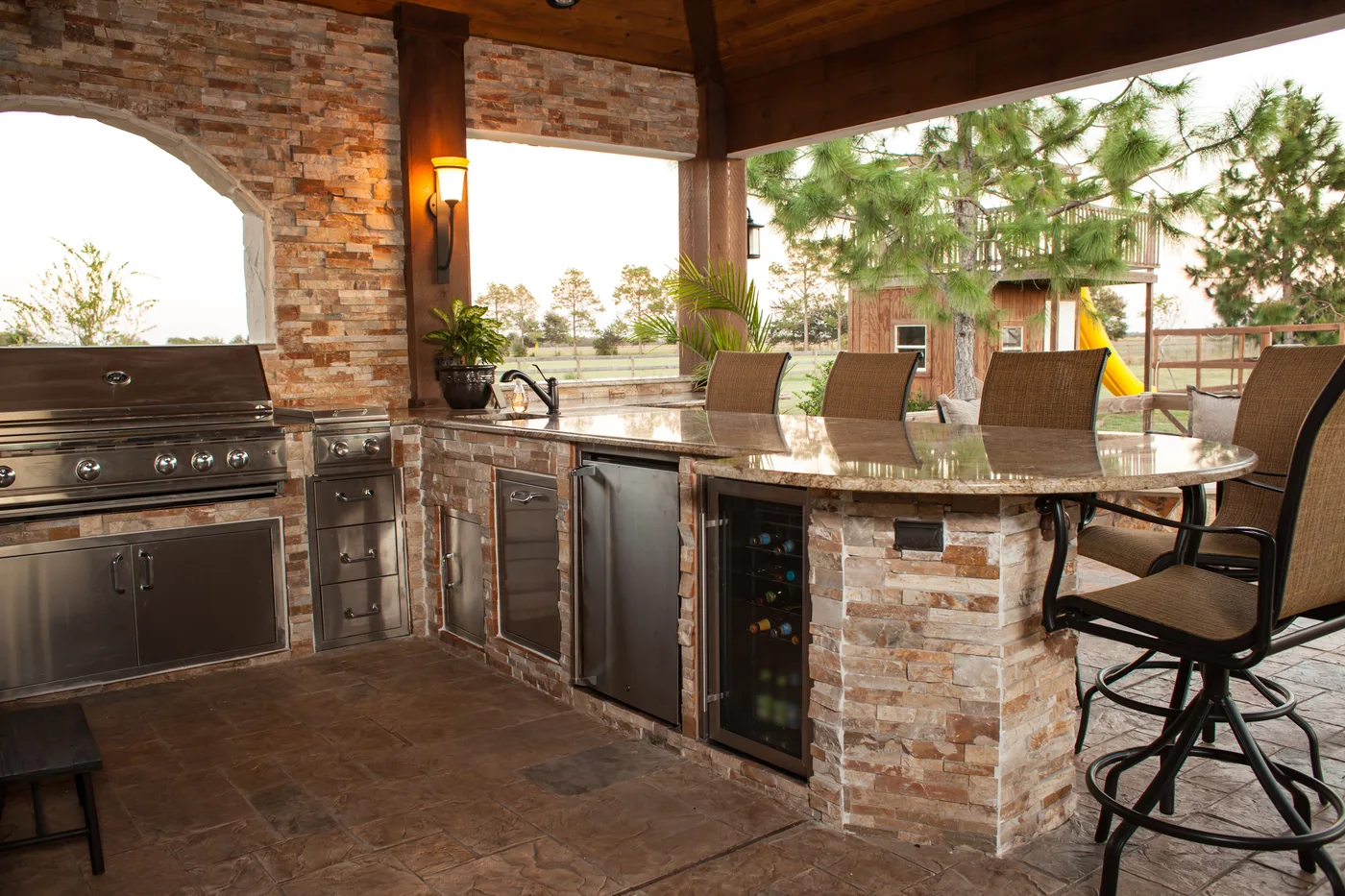
What Charlotte Weather Does to an Outdoor Countertop
An outdoor counter in the Charlotte area gets a mix of stresses that an indoor kitchen never sees. Summer brings long hours of direct sun, heat, and humidity. Spring brings heavy pine and oak pollen that settles on every flat surface. Winter is mild by national standards, but nights below freezing happen, so water that soaks into a porous surface can freeze and expand.
Those conditions point to three questions for any material. Does sunlight fade or yellow it? How much water does it absorb? And how does it handle heat from a grill, a hot pan, or a dark surface baking in the afternoon sun? A material that answers all three well will need less care and look better for longer.
The kitchen's location changes the exposure. A counter under a solid insulated patio cover gets far less sun, rain, and pollen than one on an open patio. Under a louvered pergola, exposure depends on how the louvers are set. Even under a roof, though, the counter is still outdoors and still sees humidity and temperature swings, so choose a material made for exterior use either way.
Granite: The Dependable Natural Choice
Granite has a long track record outdoors. The Natural Stone Institute notes its use for exterior cladding and paving, and describes typical granite absorption between 0.05% and 0.40% by weight, which leaves little room for water or stains to get in. Its color comes from minerals, so sunlight does not fade it the way it can fade resin-based products.
Granite handles heat well, but the Natural Stone Institute cautions against applying a strong localized heat source directly, because sharp temperature differences can start cracks. Treat it like an indoor counter: use a trivet for pans straight off the grill and keep the top clear of the grill's own clearance zone.
Sealing is a practical step rather than a strict rule. The Natural Stone Institute says many granite counters benefit from a quality penetrating sealer that further cuts moisture and stain absorption. Outdoors, where grease, pollen, and rain all land on the surface, ask your fabricator which sealer suits the specific stone and how to test when it is due for another coat.
Finish and color matter too. A honed, leathered, or busy speckled granite hides pollen and water spots better than a dark, highly polished slab, and lighter colors stay cooler in afternoon sun.
Porcelain and Sintered Stone: Low Upkeep When Rated for Exterior Use
Porcelain and sintered stone slabs are fired at high temperatures from mineral materials. Products in this group, such as Cosentino's Dekton, are marketed for outdoor countertops, and the maker's literature describes high UV resistance, very low water absorption, and resistance to freezing and thawing. Caesarstone also says its porcelain slabs are UV resistant and suitable for outdoor kitchens.
For a homeowner, the attraction is low maintenance: these surfaces generally do not need a sealer, and spills wipe off easily. The trade-offs are in fabrication. Some slabs are thin, edges can chip if they are struck, and the pattern on some products is printed on the surface rather than running through the body, which shows at cut edges and sink cutouts.
Exterior approval varies by product and thickness, so confirm the exact series is rated for outdoor countertops and that your fabricator follows the maker's outdoor support and installation instructions.
Why Standard Quartz Is a Risky Pick in the Sun
Engineered quartz is one of the most popular indoor countertops, which is exactly why it ends up in outdoor plans. The problem is the resin that binds the quartz. Caesarstone's product information says its standard quartz surfaces are not suitable for exterior use or areas exposed to UV radiation, and its published indoor-surface warranty excludes outdoor installations. Over time, sunlight can change the color.
Some brands now sell outdoor-specific quartz lines. Caesarstone's Outdoor Collection, for example, is made for exterior countertops, and its own technical guide still estimates a small color change over five years of outdoor use. If you love the quartz look, ask specifically for an outdoor-rated line and read its warranty, rather than moving an indoor slab outside.
A covered location reduces sun exposure but does not turn an indoor product into an outdoor one. Morning or late-afternoon sun can still reach under many patio roofs.
Concrete, Tile, and Stainless Steel
Concrete counters can be cast in custom shapes and colors, and they suit modern outdoor kitchens. Outdoors, the finish is the weak point. The Concrete Countertop Institute explains that outdoor concrete needs a UV-stable, breathable sealer so moisture inside the concrete can escape as the sun heats it, and that no outdoor finish is permanent, so resealing is part of owning one. Hairline cracking is also a normal possibility with concrete.
Tile is budget-friendly and comes in many styles, but the grout joints are its weak spot. Grout absorbs grease and stains, needs sealing, and can crack with movement. The uneven surface also makes rolling dough or setting a glass down less pleasant than on a solid slab.
Stainless steel is easy to clean and is common for prep areas and around grills. In direct sun, though, metal can get hot to the touch, and it shows water spots and scratches. It works best as an accent or prep section, or in a shaded location.
Quick Comparison for a Charlotte Outdoor Kitchen
No single material wins on every point. Use this summary to narrow the list, then look at full slabs and samples in the light where the kitchen will sit.
- Dense granite: strong UV and weather record; sealing often recommended; hides pollen well in speckled or textured finishes
- Exterior-rated porcelain or sintered stone: UV and freeze resistant per maker literature; little routine care; plan carefully for edges and cutouts
- Outdoor-rated quartz: quartz look with an outdoor line and warranty; some color change is still possible over years
- Standard indoor quartz: not recommended for exterior or UV exposure by major makers
- Concrete: custom shapes; needs a UV-stable, breathable sealer and periodic resealing
- Tile: lower cost; grout lines need sealing and cleaning
- Stainless steel: easy to sanitize; gets hot in direct sun and shows spots
Planning Details That Matter as Much as the Material
A good slab can still fail on a poor base. Outdoor counters are usually set on a base that will not rot or swell, such as masonry, concrete block, or a noncombustible framing system, with support for any overhang that meets the fabricator's spans. Wood framing that can move with moisture is a common reason stone cracks outdoors.
Plan the counter around the appliances, not the other way around. The grill's installation manual sets cutout sizes, clearances, and venting, and those details decide where seams can go. Keep seams out of the grill's heat zone where you can, and choose simple, rounded edge profiles that shed water and are less likely to chip.
Think about where water goes. A slight overhang and a drip edge keep rain from running down the cabinet face, and the patio or deck below should drain away from the base. If the kitchen needs a sink, coordinate the supply, drain, and winter shutoff before the top is templated.
Finally, consider the roof. A solid insulated patio cover keeps rain, direct sun, and much of the pollen off the counter, which makes almost any outdoor-rated material easier to live with. A louvered pergola gives adjustable shade and lets smoke escape when the louvers are open. Coordinate the cover, the grill's venting needs, and the counter layout together.
Plan the counter, kitchen, and cover together
Request a free consultation with Unique Patio Concepts. We will look at where your outdoor kitchen will sit, how much sun and rain it will see, and how a patio cover or louvered pergola can protect the cooking and dining area.
Request a free estimateFrequently asked questions
Can I use quartz for an outdoor kitchen countertop in Charlotte?
Use only a quartz line its maker rates for outdoor use. Major makers such as Caesarstone say their standard quartz is not suitable for exterior use or UV exposure, and indoor-surface warranties can exclude outdoor installations. Outdoor-specific quartz lines exist, but even those can show some color change over years in the sun.
Does granite need to be sealed outdoors?
Not always, but it often helps. The Natural Stone Institute says many granite counters benefit from a quality penetrating sealer that further reduces moisture and stain absorption. Outdoors, where grease, pollen, and rain reach the surface, ask your fabricator which sealer fits your stone and how to check when it needs another coat.
Will a dark countertop get too hot in the summer sun?
Dark, polished surfaces absorb more sunlight and can get uncomfortably warm in afternoon sun. If the kitchen is in full sun, a lighter or mid-tone color, a textured finish, or a roof over the cooking area will keep the surface more comfortable.
Is a covered outdoor kitchen easier on countertops?
Yes. A solid patio cover or louvered pergola reduces direct sun, rain, and pollen on the counter, which means less cleaning and slower wear. It does not make an indoor-only product suitable outdoors, so still choose a material rated for exterior use.
What countertop is easiest to keep clean of pollen?
Smooth, non-porous surfaces such as exterior-rated porcelain or sintered stone wipe clean most easily, and a speckled granite in a mid-tone hides the yellow film between cleanings. A roof overhead cuts down how much pollen reaches the counter in the first place.