
Sometimes. A retractable pergola screen may stay down in ordinary breezes when the exact system, opening size, tracks, mesh, and installation are designed for those conditions. It should not be treated as a permanent wall or assumed safe in every gust. Wind can press a large fabric panel inward, load its side guides, and make conditions at a house corner very different from a weather-app reading. Follow the installed screen manufacturer's operating limit and dealer instructions, raise the screen before conditions exceed them, and stop operating it if the fabric, bottom bar, or tracks move unevenly. The pergola roof and the screens can also have different storm positions, so one control rule should not be applied to both by assumption.
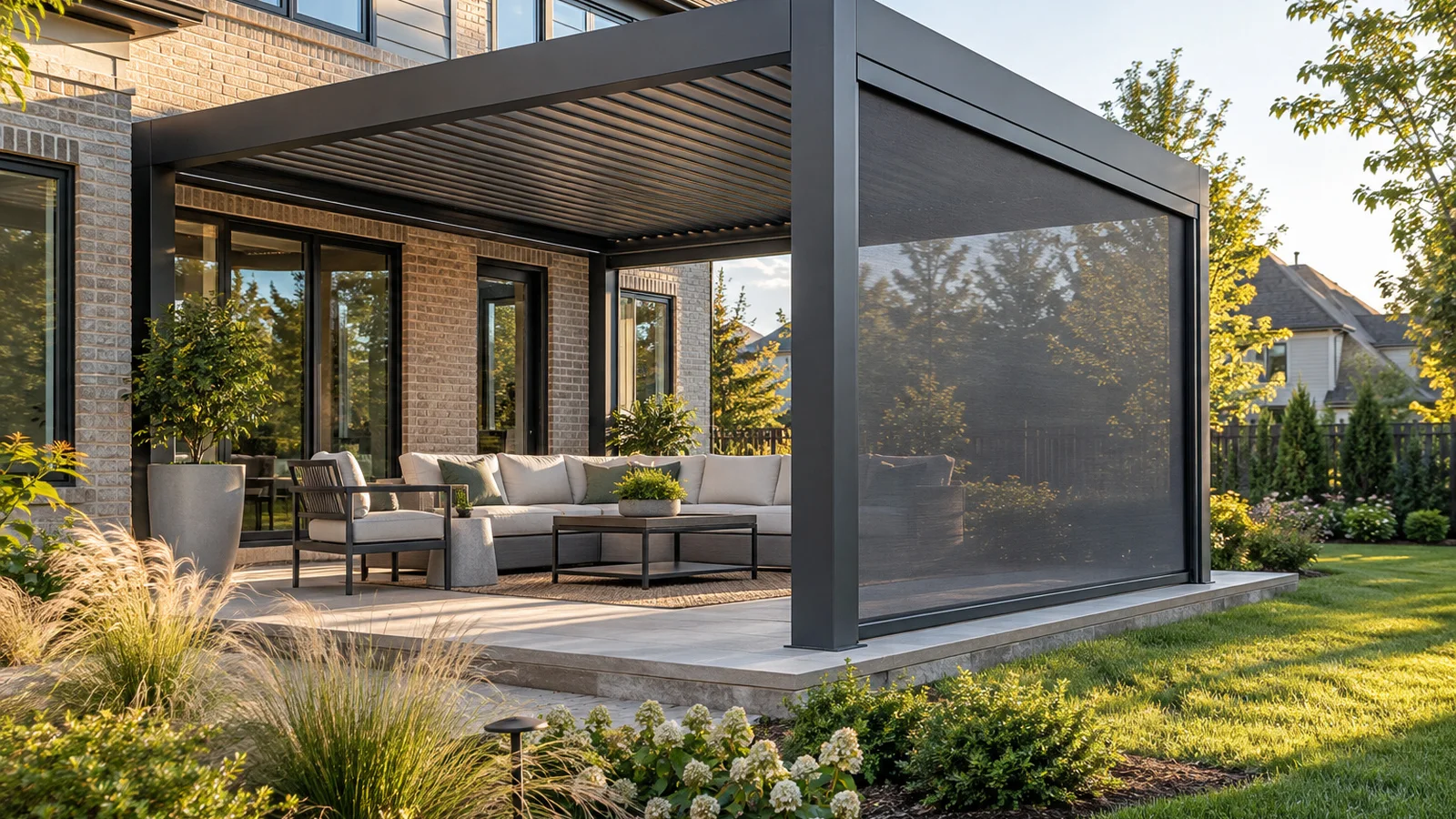
Why Isn't There One Wind Limit for Every Retractable Screen?
A lowered screen behaves like a large flexible surface. Wind pressure changes with the size of the opening, the openness and weight of the mesh, the way the fabric is held at its edges, and the strength of the housing, tracks, fasteners, posts, and beam. Two screens that look similar from across the patio can have different approved operating limits.
The site changes the load too. A screen tucked between the house and a solid privacy wall may experience less direct wind than a wide opening facing an open yard. House corners, roof edges, retaining walls, and gaps between buildings can accelerate or redirect gusts. A regional forecast cannot describe what the fabric is experiencing at that moment.
For that reason, do not borrow a wind rating from another brand, a smaller opening, a hurricane product, or a neighbor's installation. Ask for the written operating guidance tied to the selected system and dimensions. If the documentation gives conditions for retracting the screen, those instructions govern even if the pergola structure itself has a much higher design wind rating.
Which Screen Details Matter Most in a Breezy Backyard?
Start with edge retention. Basic guided screens, cable-guided products, zipper-style tracks, and self-tensioning magnetic systems do not manage fabric movement in the same way. Progressive Screens, for example, describes its MagnaTrack design as allowing the guided edge to respond to wind pressure while maintaining tension. That explains a design approach; it does not establish the limit for a different product or every MagnaTrack opening.
Opening geometry is equally important. Tall or wide spans present more fabric to the wind. Posts need to remain straight, the top housing needs adequate support, and both side guides must stay aligned from beam to floor. A sloped patio, uneven deck edge, loose trim piece, or bowed post can create a gap or make the bottom bar travel crookedly even before strong weather arrives.
Mesh selection involves tradeoffs. Denser solar or privacy fabrics can reduce glare and views but may present a different wind load than more open insect mesh. The correct choice comes from the screen manufacturer's approved combinations of fabric, width, height, track system, and exposure—not from choosing the darkest fabric and assuming every other component remains unchanged.
- Confirm the maximum approved width and height for the selected mesh and guide system.
- Measure each opening at the top, middle, and bottom, and check both diagonals.
- Verify backing and fastener locations in the pergola beam and posts.
- Keep tracks clear of downspouts, outlets, trim joints, railings, and door hardware.
- Provide a clean, continuous landing path for the bottom bar.
Do Pergola Weather Sensors Protect the Screens Too?
Not automatically. Azenco describes weather sensors and motorized screens as available parts of an R-BLADE outdoor-living system, but a sensor action for the louvered roof should not be assumed to command every accessory. The louvers may need to open or close for a particular condition while the screen manufacturer calls for the side panels to be raised. Those are separate pieces of equipment with separate limits.
Before installation, ask for a plain-language sequence for rain, routine breeze, strong wind, freezing weather, a power outage, and a failed sensor. Identify which device receives each sensor signal, whether screens move individually or as a group, and what manual control remains available. If the system is connected to an app or home-automation platform, verify that convenience commands do not override the product's safe operating instructions.
Automation is useful only when the patio is kept clear. A chair, planter, grill lid, toy, branch, or pet item in the travel path can obstruct the bottom bar. The operator should be able to see the opening while moving the screen and stop it immediately if it binds, tilts, wrinkles sharply, or makes an unusual sound.
- Label which controls operate the roof, each screen, lights, and other accessories.
- Confirm whether any wind or rain sensor actually controls the screens.
- Keep manual and power-outage instructions with the product documents.
- Do not repeatedly cycle a crooked, iced, obstructed, or partially detached screen.
- Arrange qualified service instead of opening the cassette or forcing the fabric by hand.
What Is a Sensible Wind Routine for Charlotte Homeowners?
Use the screens for the conditions they were selected to handle, then retract them before the installed system's limit is reached. On an ordinary evening, that may simply mean lowering the west screen for glare or the garden-facing screen for insects. When gusts increase, watch for pronounced inward bowing, the bottom bar lifting or tilting, fabric pulling unevenly at an edge, or repeated track movement. Those are reasons to stop and follow the product guidance rather than testing how much more it can take.
Before a forecast severe-thunderstorm window, make the screen position part of the same preparation as loose furniture and roof controls. Follow the screen manual for whether panels should be raised, then follow the pergola manual separately for the louvers and power. Do not wait until debris is moving across the yard to operate a large exterior screen.
After severe weather, inspect from the ground before cycling the system. Look for branches in the tracks, a shifted bottom bar, loose guide covers, torn mesh, standing water near controls, or anything attached to the fabric. Do not climb on the pergola or remove powered housings. If alignment has changed, keep the screen still until the installer or qualified service provider evaluates it.
How Should a Wind-Exposed Pergola Screen Plan Be Designed?
Map the real exposure before ordering screens. Note which openings face open lawn, downhill terrain, a lake, a street corridor, or the gap between neighboring houses. Record the direction of late-day sun, common summer storms, doors, furniture, and the path to the yard. A screen may be valuable on one side for glare but unnecessary on another side that would remain raised most of the year.
Then choose the pergola and screens as one coordinated assembly. The R-BLADE can accept motorized screens, but the final plan still needs compatible opening dimensions, straight mounting surfaces, power routes, controls, drainage, and clear travel paths. If dependable enclosure in frequent wind is the main goal, compare retractable mesh with a fixed privacy wall or a purpose-built screen room rather than expecting flexible panels to behave like permanent walls.
For an existing pergola, identify the exact model and inspect the beam, posts, anchoring, wiring, patio edge, and available mounting faces. Do not drill around concealed drainage or electrical routes based on appearance alone. The screen supplier and pergola dealer should confirm compatibility for the actual opening and site.
Unique Patio Concepts can help Greater Charlotte homeowners compare screen locations, pergola configuration, mesh goals, controls, and site exposure as one outdoor-living plan. The useful outcome is not the greatest number of screens; it is a layout that improves comfort and has clear, product-specific instructions for everyday wind and changing weather.
- Photograph each opening and its exposure from both inside and outside the pergola.
- Mark the house corners, open yard, slopes, walls, trees, and gaps that can redirect wind.
- Choose screen locations by glare, insects, privacy, and actual use—not symmetry alone.
- Get written operating guidance for the exact system before final approval.
- Keep the instructions accessible to every household member who uses the controls.
Plan pergola screens for the exposure you actually have
Request a Greater Charlotte pergola and retractable-screen consultation from Unique Patio Concepts.
Request a free estimateFrequently asked questions
How much wind can a retractable pergola screen handle?
There is no reliable universal number. The approved limit depends on the exact screen, mesh, track or guide system, opening size, mounting, and site exposure. Use the written guidance for the installed configuration rather than a rating quoted for another product or opening.
Should retractable screens be raised before a thunderstorm?
Follow the installed screen manual and dealer instructions. If they call for retraction before strong wind or severe weather, raise the screens early while conditions are still safe. Follow the pergola roof instructions separately because its required storm position may differ.
Will a wind sensor automatically raise my pergola screens?
Only if the specific controls were designed and programmed to do that. A pergola wind sensor may operate the louvers without controlling the side screens. Confirm the actual sensor-to-device sequence and the manual backup procedure.
Are zipper tracks or magnetic tracks better in wind?
Both are product categories, not a complete wind rating. Edge retention, tensioning, opening size, mesh, hardware, mounting, and manufacturer testing all matter. Compare approved configurations and written operating limits for the actual project instead of choosing by track label alone.
Can a retractable screen replace a fixed privacy wall?
No. A retractable screen can provide adjustable privacy, shade, and insect control, but it remains a movable fabric system. It is not a structural wall, guardrail, or impact barrier. A fixed wall may be more appropriate where continuous protection is the priority.
Can screens be added to an existing louvered pergola?
Often, but compatibility must be verified. The pergola needs suitable beam and post mounting surfaces, clear openings, a workable floor edge, protected power, and no conflicts with drainage, wiring, doors, railings, or furniture. Use components approved for the actual structure and opening.