
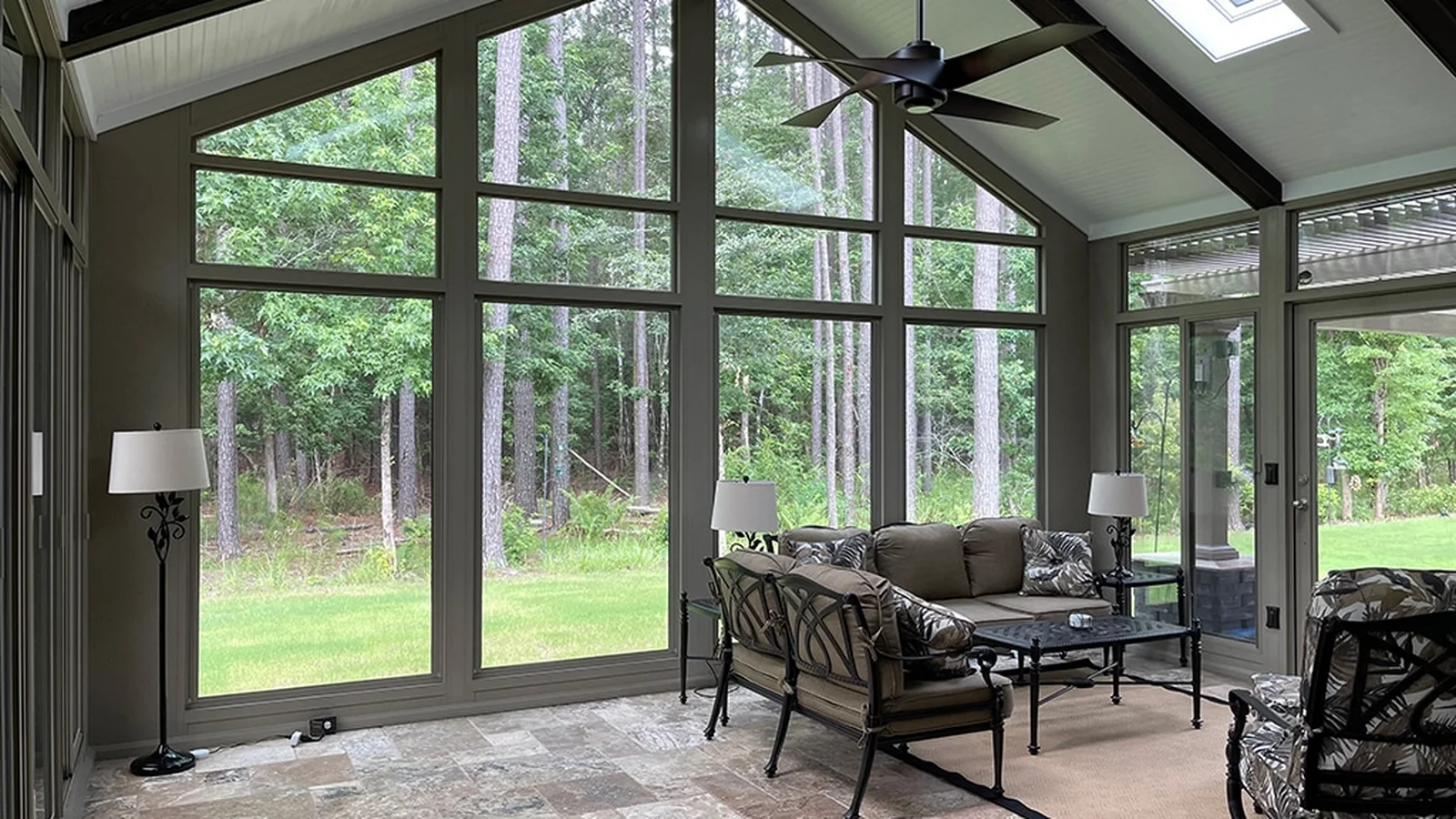
Yes. A ceiling fan can be a useful part of a sunroom, especially in a tall cathedral room where warm air collects near the roof or in a bright room that benefits from more air movement. The fan should be planned with the sunroom rather than added through a roof panel later. Its weight and movement need a suitable structural mounting point and fan-rated electrical support, while the blades and downrod need clearance from sloped ceilings, glass, transoms, doors, lights, and tall furniture. The fan's location rating should also match the room: a fully enclosed conditioned sunroom may suit an indoor model, while a seasonal or moisture-prone enclosure may call for a damp-rated model. A fan improves how occupants feel, but it does not replace insulation, operable windows, shading, or a correctly planned heating and cooling system.
Plan the mounting point before the sunroom is built
A ceiling fan is a moving load, not an ordinary lightweight light fixture. It needs support intended for the fan's weight and motion. In a conventional framed room, that commonly means a fan-rated electrical box attached to suitable framing or a listed brace. In a manufactured aluminum sunroom, the correct attachment may be a product-specific beam, mounting block, raceway, or other approved detail. The sunroom manufacturer and installer should identify that location before panels, trim, and wiring are finalized.
Do not assume any visible ceiling rib or roof panel can accept a fan. Drilling through an insulated roof panel or fastening to a decorative ceiling surface can damage the weather barrier, miss the structural member, create a leak path, or leave the fan unsupported. If the room already exists, document the roof system and available structure before choosing a fan or cutting an opening.
TEMO currently shows ceiling fans as an option within cathedral sunrooms and notes that the taller roof can leave room for a fan. That is useful design evidence, but it is not a universal mounting instruction. The attachment still has to follow the exact sunroom system, fan instructions, electrical design, and approved project details.
- Identify the structural mounting point on the sunroom plan.
- Coordinate the fan-rated electrical support, wiring route, switch, and controls before finish work.
- Keep roof drainage, seals, insulation, and weep paths intact.
- Use the installed sunroom and fan manuals for any existing room.
Fit the fan to the roof shape and glass layout
A cathedral roof often gives a fan more vertical room and a clear central location. A studio roof has a single slope and may have less height at one side, so the fan position and downrod need closer coordination. California, solarium, and other roof forms create different intersections between beams, glass, and ceiling panels. The best-looking center point is not automatically the best structural or clearance point.
Check the blade sweep in plan and elevation. Blades should remain clear of sloped roof surfaces, beams, transom glass, open windows, doors, pendant lights, cabinets, and tall plants. A long downrod can bring a fan below a vaulted ceiling, but it can also make the fan feel too low above a dining table or walking path. A low-profile fan may solve headroom in one room while placing the blades too close to an angled ceiling in another.
Choose the fan only after the room dimensions and mounting height are known. Use the fan manufacturer's current room-size, ceiling-slope, downrod, and clearance guidance for the exact model. Avoid copying a fan diameter or downrod length from a photograph because the room proportions may be different.
- Draw the full blade diameter, not just the motor housing.
- Check the lowest blade height above every walking and furniture zone.
- Confirm the fan's sloped-ceiling compatibility and maximum allowed angle.
- Keep the fan from visually crowding the sunroom's upper glass and roof structure.
Choose an indoor or damp-rated fan for the actual room
Not every sunroom has the same exposure. A fully enclosed, insulated, conditioned four-season room may function much like an interior living room. A three-season room with frequently open windows, higher humidity, or less environmental control can expose the fan to more moisture. A screened or partially open enclosure is different again.
Use the fan's listed location rating rather than its appearance. Hunter Fan identifies damp-rated models for covered spaces such as porches and sunrooms where the fan is protected from direct rain but may experience humidity. A wet-rated fan is intended for more direct weather exposure. Product categories vary, so confirm the label and installation instructions for the exact fan instead of assuming any outdoor-looking model is suitable.
The room itself should remain weather-managed. A damp-rated fan does not fix roof leaks, failed seals, uncontrolled condensation, or water entering through an open window. Resolve moisture at its source and keep the fan, controls, and electrical connections within their approved exposure.
Know what a ceiling fan can—and cannot—do for comfort
A ceiling fan moves air across people, which can make a warm room feel more comfortable. The U.S. Department of Energy summarizes the limit clearly: fans cool people, not rooms. Running a fan in an empty sunroom does not lower the room's actual temperature, and it does not remove the solar heat entering through glass.
In a tall room, gentle air circulation can reduce the noticeable layer of warmer air near the roof. Direction and speed should follow the fan manufacturer's instructions because blade designs and controls differ. The goal is comfortable circulation without papers blowing, plants drying out, or a strong draft across one chair.
For summer comfort, coordinate the fan with exterior shade, appropriate glass, window treatments, operable windows, and the room's heating and cooling plan. For cooler weather, a fan may help redistribute warm air, but it does not add heat. A three-season room does not become a four-season room simply because it has a fan, and a four-season room still needs a properly designed comfort system.
- Turn the fan off when the room is unoccupied unless another product-specific reason requires it.
- Use lower speeds when the room is cool or when papers and plants are nearby.
- Address glare and solar gain with the glass, shade, and window-treatment plan.
- Plan HVAC separately when the room is intended for dependable year-round comfort.
Coordinate lighting, controls, and electrical work
A fan with an integrated light can reduce the number of separate ceiling fixtures, but it also makes one location responsible for both air movement and general lighting. Compare that approach with recessed or wall lighting that can illuminate the room evenly after dark. In a glass-heavy sunroom, reflections and glare can matter more than raw fixture output.
Decide how the fan will be controlled before wiring begins. Wall controls, remote receivers, smart controls, fan lights, and separate fan speeds can require different conductors, boxes, and compatible components. Keep receivers and serviceable connections accessible rather than burying them inside an insulated panel or inaccessible trim pocket.
Electrical work and permit requirements depend on the address, jurisdiction, room scope, and whether the fan is part of a new addition or a later alteration. Charlotte notes that applicable electrical work is handled through trade permitting in its development process, while nearby North Carolina and South Carolina jurisdictions use their own procedures. Confirm the current requirements for the complete project and use qualified electrical installation where required.
A Greater Charlotte sunroom fan checklist
For a new room, make the fan decision while comparing roof styles. Show the mounting point, finished blade height, blade sweep, wiring path, controls, lights, operable windows, doors, and furniture on the same plan. A cathedral roof may create an easy visual center, while a lower studio roof may favor a compact fan or a different location. Let the measured geometry—not a generic catalog room—decide.
For an existing sunroom, start with the installed manufacturer, roof type, structural members, electrical capacity, and signs of moisture. Do not cut into the roof to discover what is behind it. Locate documentation when possible and have the proposed support and wiring reviewed before purchasing a fan that may not fit.
Unique Patio Concepts can help Greater Charlotte homeowners coordinate a TEMO sunroom's roof form, glass, lighting, fan location, and comfort plan as one room. The most useful decision may be a central cathedral fan, a low-profile option, or no ceiling fan when clearances are tight and another air-movement strategy fits better.
- Which roof style and structural point can support the fan?
- What are the finished mounting height, blade diameter, and clearances?
- Is the room dry and conditioned, seasonal and humid, or partially open?
- Does the exact fan carry the appropriate location rating?
- How will the fan, light, wall control, and remote receiver be wired and serviced?
- What separate shade, ventilation, and HVAC measures will handle actual room temperature?
Plan the sunroom roof and comfort details together
Request a Greater Charlotte sunroom consultation with Unique Patio Concepts to coordinate the roof style, glass, fan location, lighting, ventilation, and year-round comfort goals.
Request a free estimateFrequently asked questions
Can a ceiling fan be mounted to a sunroom roof panel?
Do not mount a fan to an insulated roof panel or decorative surface unless the sunroom manufacturer provides an approved structural mounting detail for that exact location. The fan needs suitable structural support and fan-rated electrical mounting, with the roof seals and drainage left intact.
Is a cathedral or studio sunroom better for a ceiling fan?
A cathedral roof often provides more vertical space and a natural central location, while a studio roof may require a shorter downrod, smaller fan, or adjusted position. Either can work when the structure, slope, blade clearance, and finished height are coordinated.
Does a sunroom need a damp-rated ceiling fan?
It depends on the room's exposure and the fan manufacturer's listing. A fully enclosed conditioned room may suit an indoor fan, while a seasonal room exposed to humidity may call for a damp-rated model. Use a wet-rated model where direct weather exposure requires it.
Will a ceiling fan cool a sunroom?
A fan can make occupants feel cooler by moving air, but it does not lower the room's actual temperature. Glass, shade, ventilation, insulation, and the heating and cooling system determine the room's temperature performance.
Can a ceiling fan be added to an existing sunroom?
Sometimes. First identify the roof system, suitable structural support, wiring route, clearances, moisture exposure, and current project requirements. Avoid cutting into panels until an approved mounting and electrical plan is established.