
Yes, at least at the top. The North Carolina Residential Code requires exterior stairways to have an artificial light source at the top landing, and stairs that lead down to a basement from outside also need one at the bottom landing. It does not require a light on every step. For most Charlotte decks, the required light is a fixture near the door or top of the stairs, and riser lights, post cap lights, or under-rail lights are optional additions that make the steps easier to read after dark. Because wiring is hidden inside the framing, the cleanest time to plan any stair lighting is before the treads and riser boards go on. Confirm the exact requirement for your permit with Mecklenburg County Code Enforcement or the office that covers your address.
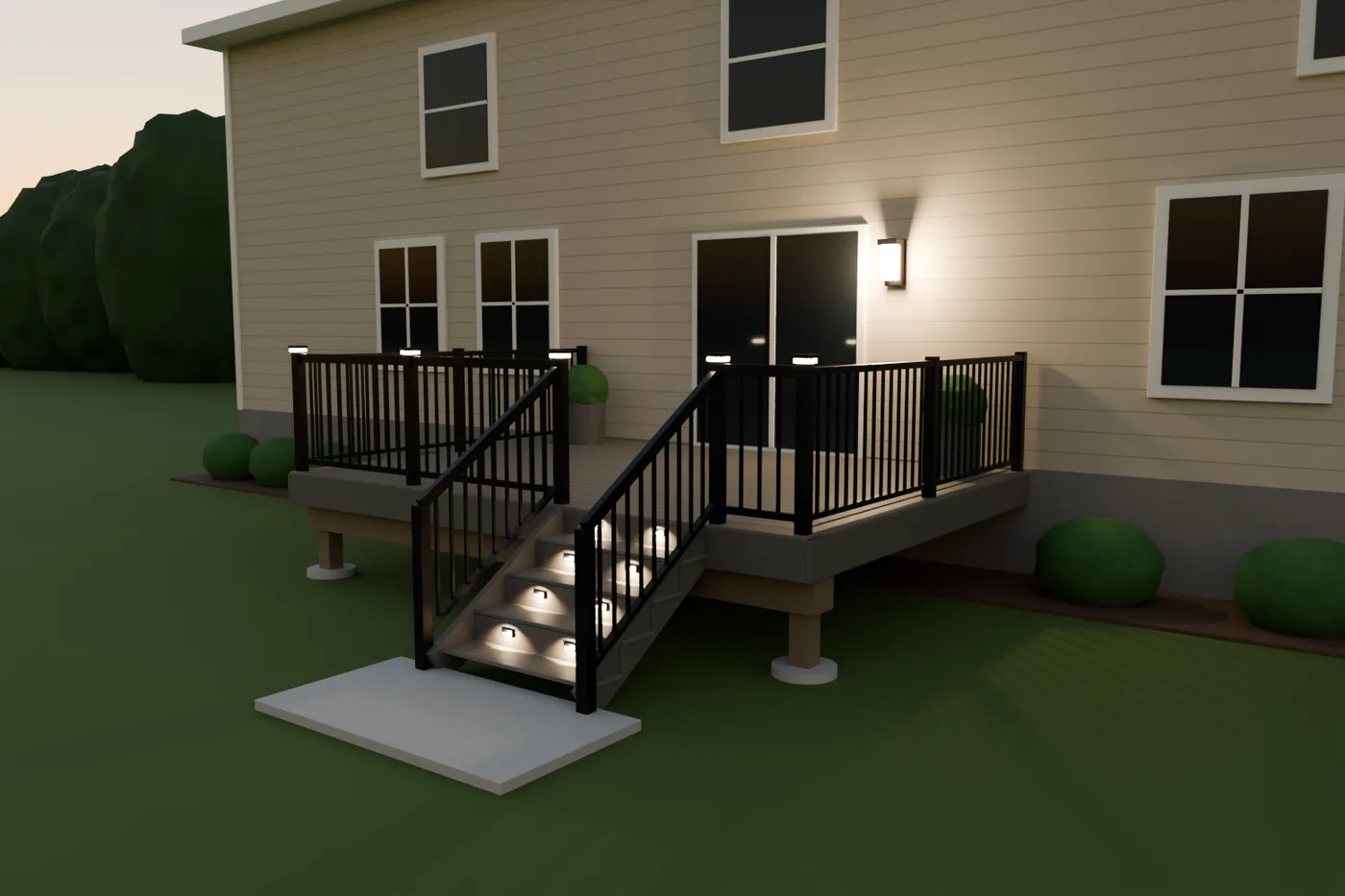
What North Carolina's Code Requires for Deck Stair Lighting
The 2018 North Carolina Residential Code, which remains the edition in force statewide while the adopted 2024 edition waits on a delayed effective date, has a short section on exterior stairway illumination. It says exterior stairways must have an artificial light source located at the top landing. Exterior stairs that give access to a basement from outside grade must also have a light at the bottom landing.
That is the whole requirement for a typical deck stair. It does not ask for a light on each step, a specific brightness at the treads, or a particular fixture style. A deck stair that drops from the back door to the yard usually meets it with a light near the top of the stairs, often a wall fixture beside the door.
Newer model codes add more detail. The 2021 International Residential Code, the model code behind North Carolina's 2024 edition, adds that stairway illumination should receive its primary power from the building wiring. Code editions and local interpretations change, so ask Mecklenburg County Code Enforcement, or the county that covers your address, what they will look for at the final inspection.
Does the Light by Your Back Door Already Cover It?
Often it can. Many homes already have a wall light beside the door that opens onto the deck. If the stairs start close to that door, the same fixture may light the top landing well enough to satisfy the inspector.
The trouble comes when the stairs sit at the far end of a long deck, wrap around a corner, or drop off the side away from the house. A fixture by the door may then light the deck surface but leave the top step in shadow. In that layout, a second fixture near the stairs, post cap lights on the stair posts, or lights built into the top risers can do the job the door light cannot.
Whether a particular fixture counts is the inspector's decision, not a rule of thumb. Bring the lighting plan into the permit conversation so the drawings show where the top-landing light will be.
- Stairs right beside the door: the existing door light may be enough
- Stairs at the far end or side of the deck: plan a light at the stair itself
- Wraparound or multi-level stairs: consider light at each landing, not only the top
- Stairs down to a basement door: plan a light at the bottom landing too
Riser, Post Cap, and Wall Lights Compared
Riser lights mount in the vertical board of each step and wash light across the tread below. They show exactly where each step begins, which helps most on longer runs or on dark composite boards that blend together at night. Trex, for example, offers both small oval riser lights and linear riser lights that cast a line of light across each step.
Post cap lights sit on top of the railing posts. They mark the edges of the deck and the start of the stairs and give a soft glow, but they light the treads less directly than riser lights. Under-rail lights tuck beneath the top rail and throw light down onto the deck surface and stair edges.
A wall fixture near the door lights a wider area and is usually the most straightforward way to meet the top-landing requirement. Many decks end up with a mix: a wall light for the landing, riser lights for the steps, and post caps to outline the deck.
How Deck Stair Lights Get Power
Most deck lighting systems are low voltage. Trex's current deck lights, for example, run on 24-volt DC power, so a transformer converts household current for the fixtures. Trex's instructions call for plugging its timer into a GFCI-protected outdoor outlet with a weatherproof cover that stays closed while the cord is plugged in, mounted vertically at least 12 inches above the ground.
Wires and splitters run along the joists and stringers, out of sight. Trex notes that stair lights are easier to work with before the treads and riser boards are in place, and that on low decks the splitters and extension wires are much easier to place before the decking goes down. Adding riser lights to a finished stair is possible, but it can mean pulling boards or running wire where it is harder to hide.
Solar post caps need no wiring, but their output depends on daylight. Cloudy winter stretches can leave them dim when the evenings are longest. They can add accent light; for the required top-landing light, ask the inspector before relying on them.
A new outdoor outlet or a hardwired wall fixture is electrical work. Plan for an electrical permit and inspection where one is required, and use a licensed electrician for line-voltage wiring.
- Where will the transformer and its outlet sit, and is the outlet GFCI-protected with an in-use cover?
- How will wires reach each stair riser before the boards go on?
- Is the transformer sized for every light you plan, including ones you may add later?
- Will the lights use the same manufacturer's system so parts stay compatible?
Avoid Glare and Choose the Right Controls
More light is not always safer. A bright fixture aimed outward at eye level can make the steps below look darker while someone walks down. Riser and under-rail lights work well because they point light down onto the treads instead of into faces. Warm, even light is usually easier to read than a few very bright spots.
Think about who uses the stairs and when. Late in the year, Charlotte sunsets come a little after 5 p.m., so the stairs may be in the dark when people come home, take out the dog, or carry dishes in from the grill. A switch inside the house, a dusk-to-dawn timer, or a motion sensor each fit different routines. Trex's timer, for instance, has a built-in light sensor and needs natural daylight to work correctly, which affects where it can be mounted.
Light also cannot fix a stair that is hard to read for other reasons. Wet leaves, pollen, and evening dew make any tread less predictable, so keep the steps clean and pair the lighting with a solid handrail where one is required.
A Planning Checklist for Deck Stair Lighting
Settle these points before framing starts so the lighting plan, the stair design, and the permit drawings agree.
- Mark where the stairs land, including any basement-access stairs
- Decide which fixture provides the top-landing light and show it on the plan
- Choose riser, post cap, or under-rail lights for the steps and deck edges
- Locate the transformer, timer, and weather-protected GFCI outlet
- Route wires through the framing before treads, risers, and decking are installed
- Pick controls: inside switch, dusk-to-dawn timer, or motion sensor
- Check the view from the top step at night for glare
- Confirm electrical permit needs with the county before work begins
Plan your deck stairs and lighting together
Request a free consultation with Unique Patio Concepts. We will look at your yard, talk through stair layout, railings, and lighting options for a new deck, and show how the lighting fits the design before construction starts.
Request a free estimateFrequently asked questions
Does code require a light on every deck step in North Carolina?
No. The North Carolina Residential Code requires an artificial light source at the top landing of exterior stairs, plus one at the bottom landing when the stairs lead down to a basement from outside. Lights on each step are an optional upgrade.
Can riser lights count as the required top-landing light?
Sometimes, but do not assume it. The code says where the light must be located, not what type of fixture it is, so whether a particular riser or post cap light satisfies it is up to the inspector. A wall fixture near the top of the stairs is the most common way to meet it.
Are solar lights enough for deck stairs?
They can add accent light, but their output depends on how much sun they get, and cloudy winter days can leave them dim. Newer model codes also call for stairway lighting to be powered from the building wiring. Ask the inspector before relying on solar lights for the required light.
Is it easier to add stair lights while the deck is being built?
Yes. Trex's installation guidance notes that stair lights are easier to install before the treads and riser boards are in place. Adding them later can mean removing boards or running wire where it is harder to hide.
Should deck stair lights be on a timer, a switch, or a motion sensor?
It depends on how you use the deck. A switch inside the house gives direct control, a dusk-to-dawn timer keeps the steps lit through the evening without anyone remembering, and a motion sensor turns light on only when someone approaches. Some homes combine them.